Sunday, November 08, 2015

2 Sem 2015 - Part Seven

Vanessa Perea
Soulful Days


By Raul Da Gama
Vanessa Perea might have a particular flair for the theatrical. This is suggested by the manner of her phrasing. Ms. Perea is able to pace herself and tell stories with each song she sings. In the case of this album, Soulful Days her range is grand and her ability to hold high notes as well as low ones is so utterly convincing that she could easily be on stage telling her story on Broadway, for instance. She also sings to the limits of the instrumentation which is small in this case and it would be interesting to listen to and watch her perform with a much bigger ensemble, with a big band. It is almost certain that she could clearly take on the size of even a full orchestra. She has that presence. Here, stripped down to one trombone with the trumpet for company there is a part of the ear that misses an ensemble of Ellingtonian proportions although Ms. Perea sometimes enunciates the lyric suggesting in the manner of another woodwind or a brass instrument creating breathtaking counterpoint for those with which she is already singing wordlessly or with words. And these are wonderful arrangements made it would seem, to fit Ms. Perea’s personality as well. She takes on the songs as if they were written for her as well.
As William Blake put it, fire will find its form, Soulful Days is a perfect convergence of content and form. Woodwind, brass and piano conjure the playful fantasy world of the music in which Vanessa Perea becomes a minstrel who almost slips back in time to the date and time of the characters’ encounters in these folk tales. Ms. Perea’s tremendous vocalising of Anthony Newley and Lesley Bricusse’s “Who Can I Turn To” is a case where the lyric makes the heartbreak and elemental loneliness come hauntingly alive. In “Jim” there is another beautiful rendition of a song that is emotively strong and requires the vocal efforts to be more evocative than in a simple song. Ms. Perea draws out her word-endings with beautiful anguish in the classic “Tenderly” and it is here that she seems to suggest the narrative palette of Broadway. Her Portuguese is also on form as she sings Antonio Carlos Jobim’s “Triste” and Caetano Veloso’s “Luz do Sol”. This is a greater test of strength and ability in a manner of speaking as vocal skills must be matched here with the ability to dream in another language and this Ms. Perea does very convincingly. But there is a surprise waiting in store for the listener and it is in none of the above.
Vanessa Perea outdoes herself as she is pitted against the trombone of Robert Edwards on Bud Powell’s classic bebop chart, “Celia”. The singer carries herself through magnificently here and it is almost worth the entire album just to get to her scatting solo on this wonderful track. Bebop, as Sheila Jordan tells her pupils in a master class, requires just as much emotion as it does speed. In the case of this Bud Powell song Ms. Perea displays this with such monumental control that it is almost too tempting to suggest, at the risk of being too presumptuous, perhaps a bebop recording next.
Track List: 
Devil May Care; Soulful Days (These Are Soulful Days); Who Can I Turn To; Too Marvelous For Words; Jim; December Blue (Martha’s Prize); Triste: Let Me Tell You; Luz do Sol; Tenderly; Celia
Personnel: 
Vanessa Perea: vocals; Robert Edwards: trombone; Matt Jodrell: trumpet; Dave Lantz: piano; Dylan Shamat: bass; Evan Sherman: drums.


Andy Bey
Pages From An Imaginary Life


By Matt Collar
Coming off his Grammy-nominated 2013 album, The World According to Andy Bey, vocalist/pianist Andy Bey delivers the equally compelling 2014 release Pages from an Imaginary Life. As with its predecessor, Pages finds the jazz iconoclast returning to his roots with a set of American Popular Song standards done in a ruminative, stripped-down style. This is Bey, alone at the piano, delving deeply into the harmony, melody, and lyrics of each song. But don't let the spare setting fool you. Bey is a master of interpretation. In his seventies at the time of recording, and having performed over the years in a variety of settings from leading his own swinging vocal trio, to working with hard bop pioneer Horace Silver, to exploring the avant-garde with Archie Shepp, Bey has aged into a jazz oracle who doesn't so much perform songs as conjure them from somewhere in the mystical ether of his psyche. Famously blessed with a distinctive, sonorous baritone warble, Bey's voice has only ripened over the years to a warm, burnished, woody resonance; a sound perfectly suited for these poignant, romantic songs. In his hands, songs like "My Foolish Heart," "How Long Has This Been Going On?," and "Everything I Have Is Yours," take on new hues of gorgeous devastation. And yet, there's still something hopeful, swinging, and urbane about Bey's performances, and songs like "Lover Come Back to Me" and "Take the 'A' Train," are, as with all of the music on Pages from an Imaginary Life, joyous, earthy celebrations of life and love.


Carol Fredette
no sad songs for me


By C. Michael Bailey
We last heard from vocalist Carol Fredette on her first Soundbrush recording, Everything in Time (2009). Her repertoire was replete with, "Light latin jazz, humid islands, and secure mainstream treatments." Fredette remains fairly true to this mix of styles on No Sad Songs For Me, specifically addressing all songs of upbeat content, if not tempo. The singer calls upon much the same band as on the previous recording, specifically pianists Helio Alves, Dario Eskenazi and Andy Ezrin.
It is notable that No Sad Songs For Me is executive produced by Pablo Aslan and Roger Davidson, two names closely associated with Latin jazz and bossa nova, styles that potently inform Fredette's repertoire here. Fredette is serious about the title and title tune for this recording. It is surprising she included Jobim's "Double Rainbow" and not his "No More Blues." These songs are upbeat and the universal mood of this recording is supercharged positive.
Fredette commands Bob Merrill's "It's Good to be Alive" and Irving Berlin's "The Best Thing for You." The former she treats as a delicate ballad and the later Latin-infused and simmered on high heat, Kevin Winard's percussion being particularly effective. The Cahn-Van Heusen chestnut "To Love and Be Loved" is gently rendered as a perfect cocktail hour ballad. Fredette's support is solid and competent, providing the singer an environment for her pristine vocal delivery of this most attractive recital.
Track Listing: 
I Am In Love; No Sad Songs For Me; The Best Thing for You; To Love And Be Loved; You’d Better Love Me; Double Rainbow; You’re Getting to be a Habit With Me; Havin’ Myself a Time; This is Always; Dancing In The Dark; Long Ago and Far Away; You Better Go Now; No Regrets.
Personnel: 
Carol Fredette: vocals; Helio Alves: piano (1, 7, 11); Dario Eskenazi: piano (4, 5); Andy Ezrin: piano (2, 3, 6, 8, 9, 10, 12, 13, 14); David Finck: bass; Kevin Winard: drums, percussion; David Mann: saxophones, flutes; Tony Kadleck: trumpet; Michael Davis: trombone; Bob Mann: guitar.


Hal Galper Trio
O's Time


By Dan McClenaghan
It's hard to be innovative in the piano trio format. The last big change happened in the late fifties and early sixties, with pianist Bill Evans' groundbreaking trio featuring bassist Scott LaFaro and drummer Paul Motian. The democratization of input and interplay changed the trio game, and countless groups have worked on refining that Evans approach ever since. A more recent development has been bombast and the inclusion of rock and poplar tunes into the jazz piano trio endeavor—with varying degree of success. Rubato playing, the stretching of the varying of tempos, in a three way improvisational way, is pianist Hal Galper's contribution to piano trio innovation.
O's Time is Galper's fifth recording in the rubato style on Origin Records. His trio, with bassist Jeff Johnson and drummer John Bishop, perfected their approach with 2011's Airegin Revisited. The current offering rolls that artistic peak out on a high plateau, twsiting the familiar ( John Coltrane "Like Sonny," Charlie Chaplain's "Smile") into different shapes, revealing different sides to the melodic threads.
"Coltrane's "Like Sonny" opens the set. The three voices bounce off each other like a cocktail party conversation, synchronous and discordant at the same time. And like that party, as the drinks flow, the volume rises toward the raucous, without, on this tune at least, actually going there. Then there's the Zen serenity of a Johnson bass solo, sparely comped by Galper.
Saxophonist Wayne Shorter's "Wildflower" has a "fractured then put back together" feeling, turbulent drums from Bishop behind Galper's relative restraint. "O's Time," written by Galper in honor of alto saxophonist/free jazz pioneer Ornette Coleman, moves away from the concept of restraint. It rolls and tumbles and sounds like, at its peak, a piano trio stuffed into a burlap bag and pushed down the stairs, with the players hanging on tight and still keeping the tune from chaos. And Charlie Chaplain's much-covered smile sounds like they're set up on the back of a flatbed truck, careening ninety miles an hours down a winding mountain road.
Exhilarating! The Hal Galper Trio shows the others guys what innovative is all about.
Track Listing:
Like Sonny; Wildflower; O's Time; Moonglazed; Smile; Our Waltz.
Personnel: 
Hal Galper: piano; Jeff Johnson: bass; John Bishop: drums


Richard Galliano
Sentimentale


By Thom Jurek
Sentimentale is accordionist Richard Galliano's debut as a leader for Resonance Records. This date marks his return to jazz after a three-album sojourn with Deutsche Grammophon recording the music of Bach, Piazzolla, and Vivaldi. His multi-national quintet here includes Israeli-born pianist and arranger Tamir Hendelman, American guitarist Anthony Wilson, Cuban bassist Carlitos Del Puerto, and Brazilian drummer Mauricio Zottarelli. The program is as diverse as the personnel. Things kick off on the spirited side with a galloping reading of Chick Corea's "Armando's Rumba," with Wilson and Galliano twinning the head as Hendelman lays down shiny chords and spirited montunos with a killer bass solo from Del Puerto before the accordionist launches into a combination of tango and jazz. Duke Ellington's "In a Sentimental Mood" opens with a near pastoral reverie before the melody is introduced by Galliano and Wilson. Hendelman's illustrative fills and comps are gorgeous without being flowery. The funky groove in Horace Silver's "The Jody Grind" is derived from Dee Dee Bridgewater's vocal version, despite Hendelman's finger popping pianism. Galliano crosses harmonic lines between both Zottarelli's drum break, spiky blues from Wilson, and soul-jazz swagger from Del Puerto. On John Coltrane's "Naima," Wilson adopts a near sitar-like sound while Galliano's crystalline, glass bead sound enters into the melody and opens it onto the accordion's higher register, offering a bright harmonic flourish in his solo. Brazilian music makes its appearance on Sentimentale as well. This take on Ivan Lins' evergreen "The Island" is equally based on the composer's earliest, Bahia-informed version rather than his post-bossa take from later years as well as singer Patti Austin's. Likewise "Verbos Do Amor," by João Donato and Abel Silva, finds Galliano's quintet engaging in inspired, multi-textured samba. There are two familiar originals here as well: "Ballade Pour Marion" is magical in this bal musette-cum-lyrical jazz setting as Hendelman's voicings twin with the accordionists', offering different timbral statements and underscoring its lush colors. Closer "Lili" is trimmed to a languid, tender duet between the accordionist and Wilson -- both of whom display their enormous gifts for lyricism (which is why they are oft-chosen accompanists for singers). Sentimentale is not only classy in its choice of material, it's canny and expert in its arrangement, interplay, and articulation. Like the best of Galliano's recordings, it displays not only his iconic signature on the accordion, but the commanding presence, communicative inquisitiveness, and elegant creativity of his spirit.

Saturday, November 07, 2015

2 Sem 2015 - Part Six

Jane Ira Bloom
Sixteen Sunsets


By Dan McClenghan
Sidney Bechet pioneered the use of the soprano saxophone in jazz in the early 20s. John Coltrane
saxophone brought that "straight horn" out of a relative dormancy of use in 1959 with his anthem-like take on Rodgers and Hammerstein's "My Favorite Things" on his Atlantic Records album of the same name. Steve Lacy took the soprano "out there," and Dave Liebman continues to stretch its boundaries.
The name Jane Ira Bloom can be added to that list of icons. For thirty years Bloom has used the soprano saxophone to give voice to fertile and uncompromising artistic spirit. She's broken ground on the introduction of live electronics into her music and has created a singular sound on a variety of multi-faceted projects—including a commissioned work by the NASA Art Program. And (talk about "out there") the International Astronomical Union named an asteroid for her: 6083janeirabloom.
Bloom's work in a quartet setting shines the brightest, on 2003's Chasing Paint (Arabesque Records), a nod to painter Jackson Pollock, 2008's Mental Weather (Outline), or the CD at hand, Sixteen Sunsets, an examination of the ballad form.
For such a forward-looking artist, this is something of a surprise. Bloom explores the standards here, along with four of her own standard form songs, with an extraordinary aplomb and patience. Her tone on the soprano is the purest, richest of sounds—as if her horn were made of gold; and her quartet, featuring Matt Wilson on drums, bassist Cameron Brown and pianist Dominic Fallacaro, play with a delicacy and restraint that gives the sound a feeling of depth and a subdued grandeur.
Bloom says she knows the words to all these songs: "I Loves You Porgy," "The Way You Look Tonight," "For All We Know," "Good Morning Heartache." These are tunes that dip down deep into longing, heartache, loneliness, tender love. Bloom's soprano saxophone is her voice. It's a voice that tells these song's stories with an exquisite grace and understanding of the vicissitudes of the human condition.
Bloom's backing trio rolls mostly in the mode of subtle accompaniment, but when she lays back the trio steps out with a jewel- like elegance, as pianist Fallacaro, with the supplest of touches, wrings every teardrop out of the melody of "Good Morning Heartache," or injects a hopeful counterpoint to the angst of the temptations on "I Loves You Porgy."
Sixteen Sunsets is, arguably, Jane Ira Bloom's most compelling recording. It's certainly her loveliest—no argument there. And the sound quality is out of this world. An asteroid is nice, but it seems a rather small celestial body for an artist that can create something as perfect as this disc. Perhaps a star, a bright one, can be found.
Track Listing:
For All We Know; What She Wanted; Gershwin's Skyline/I Loves You Porgy; Darn That Dream; Good Morning Heartache; Out of This World; Ice Dancing; Left Alone; The Way You Look Tonight; But Not For Me; Primary Colors; My Ship; Too Many Reasons; Bird Experiencing Light.
Personnel: 
Jane Ira Bloom: soprano saxophone; Dominic Fallacaro: piano; Cameron Brown: bass; Matt Wilson: drums.


Jon Davis Trio
live at the bird's eye


By Challenge
Pianist, composer, Jon Davis from New York has been performing and touring with many of the finest jazz musicians around world for more than 25 years. He has appeared on over 50 recordings. Jon Davis met with Swiss musicians Isla Eckinger and Peter Schmidlin some 15 years ago.
He appeared already on TCB 22142 ‘George Robert-Bobby Shew Quintet’, released in 2002. 
In 2013 he played a few concerts in December 2013 in Switzerland with this trio where the evening at the Bird’s Eye Jazz Club in Basel was recorded live.
Jaco Pastorius, longtime friend of Jon, said: ”Jon is my third favorite pianist…after Joe (Zawinul) and Herbie (Hancock)” and Jazz Japan mentioned that: “Jon Davis is the ultimate story teller.”
A relaxed, swinging Session in probably the best Jazz club in Switzerland with a very nice selection of great tunes from the American songbook plus a composition written by Jon Davis. Fans of the piano/bass/drums format will love this CD.


Mark Winkler & Cheryl Bentyne
West Coast Cool


By C. Michael Bailey
In 2010, jazz vocal specialists Cheryl Bentyne and Mark Winkler began a collaboration that resulted in a live show entitled West Coast Cool that they presented at different venues on the West Coast and beyond. Summit Records commits this show to digital with an album of the same title that is something special. While programming a recording is always a major production responsibility, that responsibility is lessened when the recital is one well practiced and part of a previously conceived show. Such is West Coast Cool, and this collection is the better for it.
Cheryl Bentyne is best known as the soprano voice of the Janis Siegel, Tim Hauser and Alan Paul. She has several solo recordings to her credit, her most recent being: Let Me Off Uptown (Telarc, 2005), The Book of Love (Telarc, 2006), The Gershwin Songbook (ArtistShare, 2010) and Let's Misbehave: The Cole Porter Songbook (Summit, 2012).
Mark Winkler has been a West Coast fixture for the past thirty years, releasing eleven recordings and composing dozens of songs recorded by himself and the likes of Liza Minnelli, Randy Crawford, David Basse, Jackie Ryan and Dianne Reeves. Winkler's most recent recording, The Laura Nyro Project (Cafe Pacific Records, 2013) was well received in critical corners. Together, the pair have rekindled the fire of cool circa the Eisenhower '50s, when the songwriting was exceptionally smart and stylistically razor sharp, martinis were cold and cigarettes filterless.
Some very sharp programming is employed in pairing songs in audio diptychs. The recording opens with a mash up of Paul Desmond's and Iola Brubeck's "Take 5" and Winkler's wonderfully off-kilter "Drinks On The Patio." The piece(s) are introduced with a straight salvo from pianist Rich Eames
and tenor saxophonist Bob Sheppard. Then the groove changes decidedly into the 5/4 time made famous by Dave Brubeck and his quartet in 1959. The piece transforms into Winkler's aural photograph of hipsters listening to jazz while mixing martinis, smooth ones if we judge by the precise admixture of Bentyne's and Winkler's pipes.
This same programming intelligence brought together "Talk Of The Town" and "Girl Talk" from the respective Bentyne and Winkler songbooks: drawing from Bentyne's Talk Of the Town (Telarc, 2003) and Winkler's Sings Bobby Troup (Rhombus Records, 2003). Bentyne displays her exquisite treatment of ballads juxtaposed against Winkler's perfect presentation of 1950s too cool. The two are sexy beyond belief.
The vocal pair demonstrate their potent vocal styles on the Nat King Cole medley of "Route 66/Alright, Okay, You Win/Straighten Up And Fly Right." Bentyne and Winkler weave these three classics together into a finely wrought cloth. Bentyne's smooth, perfectly balanced soprano mixes with Winkler's friendly, approachable and playful voice like cream stirs into coffee, rich and aromatic. The two skillfully slide song lyrics over one another, juxtaposing melodies until the music is ataxic with the shared joy of being sung by these voices. The duet highlight of the collection is the semi-original "West Coast Cool." Winkler shows off his lyrical wares by penning words to Neal Hefti's classic "Lil' Darlin.'" The pair pay homage to a who's who of West Coast Jazzers while their accompanying quartet lay down the Hefti silk beneath their words.
Each singer also gets solo space. Bentyne purrs on the infrequently heard "An Occasional Man" where she dances with Sheppard's slippery tenor. Bentyne brings together "All About Ronnie" and "Trouble With A Man" in a jaded lament of love lost, while drawing the sensual humidity from Horace Silver's "Senor Blues." Winkler recalls two more Troup pieces in "Lemon Twist" and "Hungry Man." He updates these pieces with his trademark user-friendly delivery, sense of humor, and exemplary musicianship. Pianist Jon Mayer kills on "Hungry Man" while organist Joel Bragg and guitarist Anthony Wilson lay out an organ jazz red carpet.
West Coast Cool is artistry that is beyond words. Wow. Just Wow.
Track Listing: 
Take 5/Drinks On The Patio; The Occasional Man; Let’s Get Lost; Talk Of The Town/Girl Talk; West Coast Cool; Something Cool; Route 66/Alright, Okay, You Win/Straighten Up And Fly Right; Senor Blues; Lemon Twist; This Could Be The Start Of Something Big; Hungry Man; All About Ronnie/Trouble Is A Man; In A Lonely Place; Cool.
Personnel: 
Cheryl Bentyne: vocals; Mark Winkler: vocals; Rich Eames: piano (1, 2, 4-8, 10); Tim Emmons: bass (1, 2, 4-8, 10); Dave Tull: drums (1, 2, 4- 8, 10); Bob Sheppard: saxophones, flute (1, 2, 4-8, 10, 11); Nolan Shahead: trumpet (3); Anthony Wilson: guitar (9); Joe Bragg: Hammond B3 organ (9); Mark Ferber: drums (9); John Mayer: piano (11); Kevin Axt: bass (11); Ron McCurdy: drums (11); Eli Brueggeman: piano: (14); George Koller: bass (14); Mark Kelso: drums (14). 


Tina May
Divas


By Dave Gelly, The Observer
"Tina May waited a long time to record this collection of songs associated with great female singers of the last century - Billie Holiday, Sarah Vaughan, Lotte Lenya, Edith Piaf et al - but it was worth it. Not only has her own singing matured, she has found the perfect arranger for the job in Frank Griffiths. To each of these dozen pieces she succeeds in imparting a delicate flavour of the original while remaining her inimitable self. Her version of Peggy Lee's Why Don't You Do Right? is particularly good, aided by Griffiths's beautifully poised clarinet."
Track list:
1. Why Don't You Do Right; 2. There's A Lull In My Life; 3. Forgetful
4. Can't Get Out Of This Mood; 5. When The World WAs Young
6. Where You At; 7. Surabaya Johnny; 8. Baltimore Oriole; 9. Let's Get Lost
10. You Don't Know What Love Is; 11. All Through The Night
Personnel:
Tina May - vocals; Winston Clifford - vocals; John Pearce - piano
Dave Cliff - guitar; Freddie Gavita - trumpet; Adrian Fry - trombone
Frank Griffith - tenor sax, clarinet; Bob Martin - alto saxophone
Andy Cleyndert - double bass; Bobby Worth - drums

Saturday, October 24, 2015

2 Sem 2015 - Part Five

Glenn Zaleski
My Ideal


By Ian Mann
I first became aware of the playing of the young Brooklyn based pianist Glenn Zaleski in March 2015 when he appeared at Dempsey’s in Cardiff as part of an international quartet led by British born bassist and composer Phil Donkin who was touring in support of his début solo album “The Gate” (Whirlwind Recordings).
Zaleski plays on that record alongside fellow American Ben Wendel (tenor sax) and the German born drummer Jochen Rueckert. The line up at Cardiff featured Donkin, Zaleski, Wendel and British drummer James Maddren and the performance is reviewed elsewhere on this site along with a look at the recording itself.
I was very impressed with Zaleski’s contribution to both the “Gate” album and the Cardiff show. He is an inventive and imaginative pianist, a fluent soloist who plays in a refreshingly unclichéd manner. I spoke to him during the interval and also found him to be a genuinely nice guy -as most jazz musicians are - and he was later kind enough to mail me a review copy of this, his début album as a leader, direct from New York. Thanks, Glenn.
A glance at Zaleski’s website http://www.glennzaleski.com shows him to be a musician with a busy schedule who plays regularly with some of the leading figures on the New York jazz scene including guitarists Gilad Hekselman, Lage Lund and Jonathan Kreisberg, bassists Ben Street and Michael Olatuja, drummers Ari Hoenig, Johnathan Blake and Colin Stranahan and saxophonist Ravi Coltrane.
On disc Zaleski has been part of a co-operative trio featuring Stranahan and bassist Rick Rosato that has released two albums to date (“Anticipation”, 2011 and “Limitless” , 2013) and has also worked with his saxophonist brother Mark (“Duet Suite”, 2010 ). He also has an extensive and varied back catalogue of recordings as a sideman which can be viewed in full on his website.
“My Ideal” is essentially a collection of Zaleski’s favourite standards and teams him with bassist Dezron Douglas and drummer Craig Weinrib, both regular collaborators. Ravi Coltrane guests on tenor sax on the closing track “I’m Old Fashioned”. Alongside the better known tunes the trio also interpret two contemporary compositions by bassist Rick Rosato and vibraphonist Peter Schlamb.
Zaleski has publicly acknowledged the influence of the Bill Evans Trio on his music and this is something that is implicit throughout “My Ideal” as evidenced by Zaleski’s lightness of touch at the keyboard and the integral, but always tasteful involvement of bass and drums.
The trio set their stall out with a gently swinging interpretation of Jerome Kern’s “Nobody Else But Me” with Zaleski darting nimbly around the keyboard supported by Douglas’ immaculate bass grooves and the quiet bustle of Weinrib’s finely detailed but unobtrusive brush work.
“Waltz For MD”, presumably a tribute to Miles Davis, was written by bassist Rick Rosato, Zaleski’s colleague from the trio with Colin Stranahan. It’s a genuine waltz (another example perhaps of the Bill Evans influence) with an engaging melody that sounds as if it could have been around for years. Zaleski explores and develops the melody in fascinating fashion and there’s also something of a feature for the excellent Douglas.
Jule Styne’s “Make Someone Happy” is a tune that is closely associated with Bill Evans. The sense of calm spaciousness that Zaleski finds in this extended interpretation owes much to the spirit of the master as Douglas and Weinrib fill the LaFaro and Motian roles to perfection.
Charlie Parker’s “Cheryl” represents a different kind of challenge but it’s one that the trio tackle with relish and aplomb as they wrap their collective fingers around Parker’s notoriously tricky compositional lines. The arrangement includes a bravado passage of unaccompanied piano from the highly talented Zaleski followed by an equally coruscating piano solo propelled by Douglas’ rapid bass lines. Weinrib enjoys a sparky drum feature and supplies briskly brushed support elsewhere.
A luminous arrangement of Johnny Green’s classic “Body and Soul” then offers further evidence of Zaleski’s way with a ballad but also brings a contemporary sensibility to one of the most frequently recorded items in the jazz canon. There’s also a gorgeously melodic solo from Douglas, a player who impresses throughout the album.
“REL” was written by one of Zaleski’s young New York based contemporaries, the vibraphonist Peter Schlamb. Its modern feel and contemporary rhythms represent a welcome variation from the predominately “Songbook” material. Zaleski and his colleagues serve their friend’s composition well with Weinrib enjoying another brief moment in the spotlight.
“Arietis” is a little known Freddie Hubbard tune that is given a lively, boppish reading by the trio with Zaleski in sparkling form at the piano and interacting well with the busy rhythm section of Douglas and Weinrib. Bassist Douglas again features strongly with yet another fluent and imaginative solo.
A thoughtful and evocative passage of solo piano introduces Richard A.Whiting’s title track . The playing throughout this piece is delightfully lyrical and includes a melodic solo from Douglas alongside the leader’s limpidly flowing piano and Weinrib’s admirably understated brush work.
Jerome Kern tunes bookend the album as Ravi Coltrane finally comes to the table with his own arrangement of “I’m Old Fashioned”. Coltrane’s tenor almost inevitably sounds a little like that of his father as he brings something of a “spiritual jazz” feel to the opening section of the piece. There’s a later injection of pace that leads to a feverishly inventive Zaleski solo that develops into a thrilling dialogue with Weinrib’s drums. There is an authority to Coltrane’s own solo that is clearly steeped in the family lineage.
“My Ideal” was immaculately recorded in New York by an engineering team of Michael Brorby and Dave Darlington with Zaleski himself producing. The final mix captures all the nuances of the trio’s playing and the three musicians sound good both individually and collectively.
Overall the album is a good representation of Zaleski’s talents and it is clear that he is a young musician with an enormous technical facility and a high degree of potential. It’s an excellent recording in its own right but it is a rather conservative one with arguably an over reliance on the standard repertoire. It is a success on its own terms but good as it is I’d have liked to have heard some of Zaleski’s own compositions and would have appreciated more of a contemporary feel overall.
Perhaps this will represent the next step for Zaleski, although to be fair this may already be what he is doing with Rosato and Stranahan. I’ve not heard either of those albums and thus can’t really comment.
In any event I really like his playing and Glenn Zaleski is clearly a young musician to keep an eye on in the years ahead.


Dario Carnovale
Emersion


By Bruce Lee Gallanter 
The only member of this quartet with whom I am previously familiar is saxist Francesco Bearzatti who has three discs as a leader also on Auand and is a member of several other bands including the great trombonist Gianluca Petrella. Mr. Bearzatti has a strong, warm and marvelous tone on tenor sax which fits perfectly with the McCoyish piano of Mr. Carnovale. After the majestic theme in ‘Part 1′ of the title piece, the quartet work their way through group and solo sections, all of which evolve in an impressive, organic or thematic way. Both Mr. Carnovale on piano and Mr. Bearzatti on tenor are gifted soloists and they work especially well together tossing lines back and forth effortlessly. This disc is a well produced studio recording, perfect in many ways. If it were played on jazz radio and heard by enough listeners, this could be a hit. No this is not smooth in any way but it is a successful effort on many other levels.
Personnel:
Francesco Bearzatti - tenor saxophone; Dario Carnovale - piano; Simone Serafini - double bass;
Luca Colussi - drums


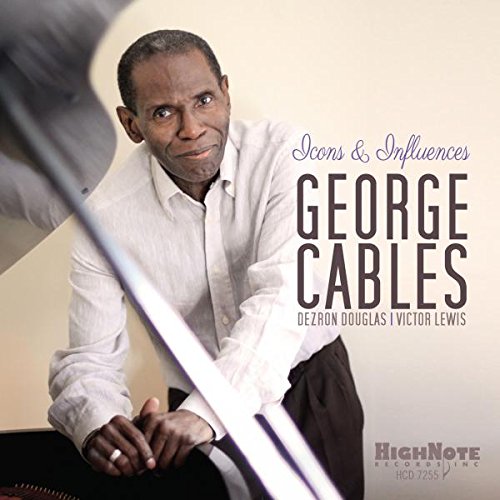
George Cables
Icons & Influences


By Waterfront
George Cables is the embodiment of elegance and sophistication.
Piano trios dot the landscape like taxi cabs and Starbucks when visiting New York. Good pianists are a dime a dozen, great pianists include a fixture on the Big Apple scene and that pianist is George Cables. As a leader George goes back to his 1975 debut with Why Not while most people are perhaps more familiar with his work with such artists as Woody Shaw and Dexter Gordon along with drum legend Victor Lewis. Given that Cables has usually allowed bassists free reign on the bandstand the end result takes the standard piano to a new level of harmonic conversation.Some tunes here speak for themselves and include "Cedar Walton" and "Farewell Mulgrew." There are other somewhat surprising and slightly eclectic tunes such as "Nature Boy" and a more deconstructed Dexter Gordon riff on "The Very Thought of You." The adaptability and trust that runs throughout this trio would give some the impression of a group that may have been together a decade or more. A utility infielder travels his baseball path with a plethora of skills and the ability to plug himself into any situation, George Cables is no different. The rhythm section of Dezron Douglas and Victor Lewis add a textural lift to the ensemble and set this trio apart from their contemporaries.A few "rarities" pop up in the form of the Bill Evans tune "Very Early" and a warm reharm of the Benny Golson tune "Blue Heart." This is a master class for pianists working the trio format, not everything has to be from the Cole Porter catalog, it has to be from your heart and from your soul. George Cables gives us a keen insight into his lyrical soul and we are better for it.


Sachal Vasandani
Hi - Fly


By Ken Dryden
Many critics have lamented the relatively rare appearance of memorable male jazz vocalists over a stretch of several decades. Sachal Vasandani is a promising singer gifted with a wide range and an expressive, strong tone that brings out the essence of each lyric. His third CD finds him backed by pianist Jeb Patton (whose work with the Heath Brothers has garnered considerable praise), bassist David Wong, and drummer Kendrick Scott. The imaginative arrangement of the standard "The Very Thought of You" is a group effort with a strong assist from Erik Privert, utilizing a breezy Latin rhythm and featuring a potent backing line by guest John Ellis on tenor sax. Two duets feature the legendary vocalist Jon Hendricks: a hilarious rendition of "One Mint Julip," which also has some fun-filled scat singing by both men, and Randy Weston's "Hi-Fly," which adds a newly written lyric by Vasandani. The leader's rich voice is best on display with his thoughtful interpretation of "Here Comes the Honey Man" (a duet with Patton), which segues directly into "There's a Boat That's Leaving Soon for New York" (both pieces are from George Gershwin's Porgy and Bess), the latter in which Vasandani's vocal sounds as if it has long been part of his repertoire. The singer also penned several originals, including the hip "Babe's Blues" (featuring the rising young trumpeter Ambrose Akinmusire) and the haunting, deliberate ballad "Flood." There's an obvious hint of Frank Sinatra in his moving performance of "All the Way," a duet with Patton that closes the album with a flourish.


Holly Hofmann & Bill Cunliffe
Three's Company


By Michael G. Nastos
Flutist Holly Hofmann and pianist Bill Cunliffe are on their third time around formally in the recording studio, even though they’ve performed with each other numerous times for 20 years. Three’s Company does, in fact, include four duet performances, but the other half of the tracks show up in trio settings, featuring one cut apiece with violinist Regina Carter, trumpeter Terell Stafford, clarinetist Ken Peplowski, or drummer Alvester Garnett. There’s a mix of predictability and certain surprise in these standards and originals, as you expect from seasoned veterans seeking new horizons. Cunliffe and Hofmann have always strived for perfection, but also offer a great deal of lyrical depth and substance as these thoroughly professional mainstream jazz players do their thing. Of the duets, they do a quaint two-step version of “Too Late Now,” showcase the Cunliffe tribute to the late Jorge Dalto on a Chick Corea-ish, Spanish heart-styled “Dalto” especially from the pianist’s solo, go classical on Gabriel Fauré’s somber ballad “Pavane,” and close with another Cunliffe original (there are four on the date,) the simple “Farewell.” Carter’s violin is always robust, but here stretches out for the nine-minute, melancholy but lucid version of “Star Crossed Lovers,” mixing in some counterpoint with Hofmann. Peplowski’s feature “Reunion” departs from expected strict swing into a modernistic 6/8 modal framework, loaded with staccato accents, while Stafford’s playful, snappy trumpet identifies the title selection, Hofmann’s lone composition, and the most jazz-oriented tune here. Where drummer Garnett’s strength lies in his flexibility providing traditional to contemporary rhythms, “Sweet Andy” is more of a post-bop jam, with everybody cutting loose, inspiring Cunliffe and Hofmann to play a fleet unison line. While there’s nothing groundbreaking about this album, the individuality of each player forms a mutual bond, and a unified whole without a bassist or central timekeeper. Cunliffe and Hofmann are always in good company together, but here they raise the stakes on what sounds like a very comfortable union, producing a winning product.


Cyrus Chestnut
A Million Colors In Your Mind


By Matt Collar
Roughly 18 albums into his career, jazz pianist Cyrus Chestnut delivers his HighNote record label debut with 2015's A Million Colors in Your Mind. With a title that borrows inspiration from a short story by Mexican author Maria Cristina Mena, the album finds Chestnut once again delving deep into his own colorfully chorded and swinging set of well-chosen cover songs. Although in his mid-fifties at the time of recording, Chestnut nonetheless wanted to record an album in which he could commune with musicians who were slightly older and more seasoned than himself. Accordingly, backing Chestnut here are the supremely intuitive duo of bassist David Williams and drummer Victor Lewis, who certainly bring decades of experience to Chestnut's album and, based on cuts like the trio's fluid take on Frank Loesser's gospel-infused "Brotherhood of Man" and Lewis' own "From a Tip," have an affinity for each other's playing. That said, the choice to work with experienced musicians is not a new one for Chestnut, who came up early in his career backing legendary vocalist Betty Carter, a position he inherited, in part, from Carter's longtime collaborator pianist John Hicks. Here, Chestnut even plays a Hicks composition, the atmospheric waltz "Yemenja." Elsewhere, Chestnut and his trio dig into a handful of urbane, soulful songs, from a sparkling take on late bassist Scott LaFaro's "Gloria's Step" to an inspired reworking of Lionel Richie's "Hello" and a languid, Latin-inflected version of Duke Ellington's "Day Dream." Ultimately, Chestnut continues to dazzle with A Million Colors in Your Mind, revealing ever more tantalizing musical layers.

Friday, October 23, 2015

Mark Murphy 1932 - 2015


By The Associated Press
Legendary jazz vocalist Mark Murphy has died in New Jersey after a lengthy illness that kept him from performing since 2012. He was 83.
Manager Jean-Pierre Leduc says Murphy died Thursday at the Lillian Booth Actors Home in Englewood.
Murphy was raised in Syracuse, New York, where he was discovered at a jam session by Sammy Davis Jr. in 1953.
He was a six-time Grammy Award nominee who sang with a wide range of techniques, from scatting and vocalese to spoken word. He released more than 40 recordings since making his debut with the 1956 album "Meet Mark Murphy."
He worked as an actor in London in the 1960s before returning to the U.S., where he began recording highly acclaimed albums for the Muse label including tributes to Jack Kerouac and Nat King Cole.

Monday, October 12, 2015

2 Sem 2015 - Part Four

Giovanni Guidi Trio
This Is The Day


By Adrian Pallant
If you admire expressive watercolour impressionism in contemporary jazz, this album by the trio of Italian pianist Giovanni Guidi, who is thirty this year, with its evocations of fragile, rain-teary washes across a broad, receptive canvas will prove particularly satisfying.
On This Is The Day, Italian pianist Guidi and colleagues Thomas Morgan (double bass) and João Lobo (drums) follow up their 2012 debut City of Broken Dreams with another meditative sequence of diaphanous delicacies, bearing some resemblance to the restrained spirit of Tord Gustavsen or Ketil Bjørnstad. The pianist's big break came when compatriot trumpeter Enrico Rava was so drawn to his focused, minimalist attributes, at Siena Jazz's summer school, he decided to include him in his own groups (also recording on the ECM label).
Here, Guidi again reveals his finesse both as trio leader and, for nine of the twelve tracks, composer. He describes his colleagues and his approach thus: "What I really admire about Thomas and João is the depth and intensity with which they approach music of any kind. All the pieces that I write for this group are written with them in mind. Thinking about the characteristics of their playing – free, direct, profound and with a strong emotive element – I try to bring these qualities also into the music that I write."
Clearly illustrating that aspiration, opening number Trilly ebbs and flows like the gentlest breezes across an Aoleian harp. Softly-brushed cymbals and snare, along with spacial double bass, create the elevation for Guidi's restrained rubato melodies; and whilst the theme itself is almost of nursery rhyme simplicity, the collaborative, atmospheric effect is spellbinding. Carried Away exudes a decidedly Balkan air of melancholy which, as a night sky, gradually illuminates, coruscating with cymbal, high piano and bass highlights; and Game of Silence's weight of emotion suggests the dark, filmic qualities of Italian cinema.
The Cobweb is noticeably freer, as Morgan's quietly agile, spidery bass weaves its way through heavy, clanging, pianistic outbursts and disturbing percussive flutters before segueing into João Lobo's Baiiia, where Guidi's brighter piano motifs attempt to rise above the pervading disquiet. Echoes of Gustavsen are to be found in The Debate, where subtle, bluesy octave melodies roll both prominently and impudently over animated bass and percussion – a welcome moment of esprit.
Central to the sequence is the exquisite tenderness of Guidi's Where They'd Lived. For over ten minutes, the trio explore the luminous landscape surrounding its memorable, yearning theme which possesses lyrical attributes usually associated with Michel Legrand or John Barry. And the arrangement of Osvaldo Farres' Quizas quizas quizas (translated, Maybe) smoulders idly until blossoming into playful Cuban elegance, revealing delightful individual detail from each of the players.
Brief, turbulent Migration leads to a mistier variation of opening tune Trilly, – and then, interesting to hear this trio's take on Livingston/Malneck standard I'm Through With Love – typically wispy, yet with a cheerful resignation which provides a glimpse of Guidi's potential for something more sprightly. To close, his pictorial The Night It Rained Forever lashes descriptively at the windows, Morgan's ominous, sustained arco bass providing its drama until, finally… quiet peace.
For much of its 74 minutes, This Is The Day rarely breaks out of its state of subdued equilibrium. Nevertheless, it would be a mistake to treat it as background, and to miss its subtle sublimity.


Big Screen (Skelton, Newton, Farmer)
Take One


By TheGuardian
Big Screen is a trio: pianist David Newton, bassist Tom Farmer and drummer Matt Skelton. Their aim, to recast cinema music in the jazz idiom, is not new but the possibilities are endless. When it comes to bold originality and delicacy of touch, Newton is unbeatable. He can re-harmonise a tune so persuasively that you almost forget how the original sounded. And they choose some unlikely tunes too. How do you set about the theme to Chariots of Fire, or When Somebody Loved Me, the song from Toy Story 2? You’ll be amazed by the transformations that emerge.


Alan Broadbent and NDR Bigband
America The Beautiful


By Dan Bilawsky
In the brief liner essay that accompanies America The Beautiful, pianist Alan Broadbent notes that he has "an aversion to being clever," but the rest of the music world never received that memo. Everybody from Irene Kral to Diana Krall and Charlie Haden to Charlie Rich has benefited from his brilliance with a pen and/or a piano. Now Broadbent gets a chance to live within his own well-written constructs.
America The Beautiful finds Broadbent in the company of Hamburg's NDR Bigband, revisiting a world that he thought he'd left for good when he left the employ of bandleader Woody Herman
more than four decades ago. And it's a welcome return, for he has a lot to say in this area. He uses the DNA of "All The Things You Are" to create something new ("Between The Lines"), he gives the great Billy Strayhorn a tribute that's weightier than what the man would've written himself ("Sonata For Swee' Pea"), and he creates a moving tribute to Herman that's simply breathtaking ("Woody 'N' Me").
As things continue, Broadbent plays with textures and counterpoint ("Covenant"), steps to the fore with his piano on a brief-and-direct winner written long ago ("Love In Silent Amber"), swings away on a tribute to pianist Sonny Clark piano ("Sonny's Step"), and introduces a tribute to his wife all by his lonesome ("Mendocino Nights"). And then there's the title track, which is revitalized with a facelift, yet retains its stirring qualities.
While Broadbent's charts and piano get a lot of well-deserved attention here, this is a collaborative affair, and the NDR Bigband proves to be quite the match for the man with top-billing. It presents a warm-and-rich, balanced-and-brandied sound that's miles away from the screaming brass-meets-silken saxophone sound that's so prevalent in more traditional outfits. The band does have plenty of firepower, but the big guns and heavy ammunition are reserved for the right times.
This group operates like a single well-oiled machine, but the individual personalities shouldn't be discounted or overlooked. Tenor saxophonist Christof Lauer proves to be a monster talent, whether burning or bathing in the glow of Broadbent's writing, bassist Ingmar Heller makes his mark on a couple of occasions, and several other band members get some space to shine.
America The Beautiful is remarkable, and that should come as no surprise. The NDR Bigband has proven highly capable on many occasions before, and Alan Broadbent seems to excel in every musical setting he settles into.
Track Listing: 
Between The Lines; Sonata For Swee' Pea; Woody 'N' Me; Covenant; The Long White Cloud; Love In Silent Amber; Sonny's Step; Mendocino Nights; America The Beautiful.
Personnel: 
Jörg Achim Keller: conductor; Thorsten Benkenstein: trumpet, flugelhorn; Ingolf Burkhardt: trumpet/flugelhorn; Claus Stötter: trumpet, flugelhorn; Reiner Winterschladen: trumpet, flugelhorn; Felix Meyer: trumpet (4); Fiete Felsch: alto saxophone, soprano saxophone, flute; Peter Bolte: alto saxophone, flute; Gabriel Coburger: tenor saxophone, soprano saxophone, clarinet (2); Christof Lauer: tenor saxophone, clarinet; Lutz Büchner: tenor saxophone, soprano saxophone, clarinet, flute; Frank Delle: baritone saxophone, bass clarinet, flute; Edgar Hertzog: bass clarinet, baritone saxophone, flute (4); Dan Gottshall: trombone; Rainer Sell: trombone; Stefan Lottermann: trombone; Ingo Lahme: bass trombone; Alan Broadbent: piano; Ingmar Heller: double bass; Marcel Serierse: drums; Martijn Vink: drums (4).


Benny Green
Live In Santa Cruz !


By Mark Corroto
We hope you've made the journey these past thirty plus years with pianist Benny Green. From hotshot young lion to keeper of the jazz flame he has consistently electrified audiences with his live performances. Live In Santa Cruz recorded at the Kuumbwa Jazz Center follows up on a recording he made as bassist Ray Brown's sideman twenty years ago. Green built a career, first as an apprentice to Betty Carter, then Art Blakey, Freddie Hubbard, then Brown. His career as a leader found early success with first Blue Note, then Telarc, and more recently, his revival with Sunnyside. As the market, or perhaps marketing departments, ebbed and flowed into then out of a taste for traditional jazz, Green's exposure has waxed and waned.
What hasn't diminished are his skills at the keyboard, and more importantly, his knack for entertaining audiences.
Playing Santa Cruz, side-by-side with Testifying: Live At The Village Vanguard (Blue Note, 1992) confirms his status as a true jazz maestro. The pianist recorded these tracks on his annual performance at Kuumbwa Jazz Center, and the audience ready, willing and primed for his appearance. The nine tracks are all originals, they range form the firecracker opener "Certainly" to the slow drag blues "Golden Flamingo," and an intricately simple ballad "Forgiveness."
Green's music works best in a trio format. Here he calls upon his musical twin, drummer Kenny Washington and bassist David Wong to favor the music. The crowd's energy is felt throughout. Green reintroduces "Phoebe's Samba," a composition written for his sister and recorded years ago on Lineage (Blue Note, 1990). The energy rises here and on his mayhem cyclone tribute to the hard bop pianist "Sonny Clark." Green's facility and hardwire swing carry the day. "Bish Bash" summons the spirit of Bud Powell at his bebop height, and the final track "Anna's Blues" has the crown on their feet. Green's music dares you to not clap, dance, or smile. Can't be done.
Track Listing:
Certainly; Phoebe’s Samba; Catus Flower; Sonny Clark; Golden Flamingo; Tales Of Malone; Forgiveness; Bish Bash; Anna’s Blues.
Personnel:
Benny Green: piano; David Wong: bass; Kenny Washington: drums.


Simcock & Goloubev
Reverie at Schloss Elmau


By Bruce Lindsay
Schloss Elmau, in Bavaria, was the recording venue for pianist Gwilym Simcock's Barclaycard Mercury Prize nominated solo album Good Days At Schloss Elmau (ACT Music, 2011). In March 2013 Simcock returned to the Schloss in the company of double bassist Yuri Goloubev. The result is Reverie At Schloss Elmau. It's the first duo album by these stylish players, although they have played and recorded together in many ensembles over the years including trios with drummers James Maddren and Asaf Sirkis.
Simcock gets most of the writing credits here—five, to Goloubev's three. Simcock's compositions are perhaps a little more jazz-oriented than Goloubev's, but there's not a vast degree of difference. Both men display a love of melody in their writing; each one shows a delight in using space to enhance the emotional impact of the music. The result is an impressive collection, the generally relaxed and reflective compositions combining with excellent recording (by Adrian von Ripka) to create an intimate mood.
Goloubev originally wrote "Lost Romance" for accordion—something which is not obviously apparent as bass and piano combine on this romantic ballad. Simcock's "Antics" is suitably jittery and urgent, the duo seemingly racing each other to a distant finish line. It's an enjoyable but uncharacteristic shift in tempo and rhythm. Calm returns immediately, courtesy of another Simcock composition, "A Joy Forever," featuring Goloubev's arco bass—which, appropriately, is a thing of beauty.
"Flow" is another of the pianist's compositions which is aptly described by its title—a rolling, flowing, melody. Goloubev bows his bass with precision and grace, despite working for the most part in what Simcock describes as an "unfeasibly high register" for the instrument. "Vain Song" is dedicated by Goloubev to his musical partner (the title is a nod to Simcock's own "Plain Song.").
"Reverie" was written for piano and double bass by the 19th century Italian composer Giovanni Bottesini. Simcock and Goloubev perform the piece beautifully, the bass readily evoking the mood of the title while Simcock's spare and unshowy accompaniment gives the piece more of a jazz flavor than it traditionally receives. The piece sits comfortably alongside Simcock and Goloubev's own writing: a testament to the timeless quality of the performances and compositions on Reverie At Schloss Elmau.
Track Listing: 
Pastoral; Lost Romance; Shades Of Pleasure; Antics; A Joy Forever; Non-Schumann Lied; Flow; Vain Song; Reverie.
Personnel: 
Gwilym Simcock: piano; Yuri Goloubev: bass.


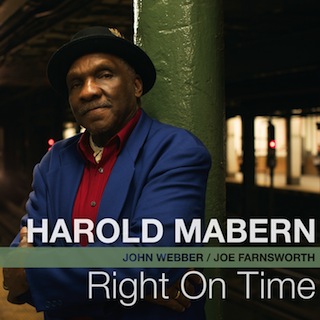
Harold Mabern
Right On Time


By JazzMessengers
Any day that you get to hear jazz pianist Harold Mabern is a great day, and on his new release, Right On Time, you get two of those days with his trio distilled into one irresistible record. This recording was made on weekend of his 77th birthday party and the extra energy on these tracks is unmistakable. They revel in the complete Mabern experience, delivering everything from classic blues and swinging standards to delicate ballads and modal tempests.
Recorded live at Smoke Jazz Club, March 22 & 23, 2013
Personnel:
HAROLD MABERN, piano; JOHN WEBBER, bass; JOE FARNSWORTH, drums
Tracks:
01. Dance with Me; 02. Seven Steps to Heaven; 03. Don't Get Around Much Anymore
04. My Favorite Things; 05. To You; 06. Edward Lee; 07. Making Our Dreams Come True
08. Charade; 09. Blues for Frank 'n' Paul 'n' All; 10. The Nearness of You; 11. Cherokee

Sunday, October 11, 2015

2 Sem 2015 - Part Three

Kenny Werner
The Melody


By Dan Bilawsky
The Melody lives up to its name, but not through the simple act of melodic dissemination: pianist Kenny Werner and his trio mates don't make their mark by addressing melodies so much as byundressing them, revealing what's beneath these tuneful coverings. All seven songs on the album—four Werner originals, a Broadway classic, and two standards—speak to the intimate art of dialogue, the respect that exists between these three men, and the inherent possibilities that live within a song.
Once polished with the cloth of invention, every piece here, be it a previously-recorded Werner tune, a new(er) original, or a classic, seems new. "Try To Remember," for example, shrugs off any maudlin qualities and nostalgic weight in favor of starry-eyed wonder, eventually revealing a touch of Sonny Rollins' "St. Thomas"; Dave Brubeck 's "In Your Own Sweet Way" is playful, quirky, and charming all at once; "Who?" is consistency and movement rolled into one; and "Beauty Secrets" is a wholly engrossing meditation on dark-complexioned allure, existing in the shadows while reflecting slivers of lights.
A flexible concept of the individual's function is central to the sound of this trio, as is the notion that no idea is so powerful as to require unwavering allegiance. This music morphs frequently, as rhythms prance, flow, stutter, and stride in unexpected ways, and each musician has a hand in making that happen. Drummer Ari Hoenig is just as likely to drive the action as he is to trace the melodic contours of a passage, bassistJohannes Weidenmueller is a grounding force and a harmonically astute linchpin, and Werner is a wide-open reservoir of musical knowledge, imparting intelligent thought with his every movement. With a decade-and-a-half of shared experiences and several strong albums already under its belt, it should come as no surprise that this trio sounds as good as it does.
Track Listing: 
Try To Remember; Who? Balloons; 26-2; Voncify The Emulyans; In Your Own Sweet Way; Beauty Secrets.
Personnel:
Kenny Werner: piano; Johannes Weidenmueller: bass; Ari Hoenig: drums.


Albert "Tootie" Heath/ Ethan Iverson/ Ben Street
Philadelphia Beat


By Jeff Tamarkin
In their jointly written “Artist’s Choice” column on Tootie Heath for JazzTimes, pianist Ethan Iverson and bassist Ben Street spotlighted the diversity of the drummer’s sideman work, choosing a handful of recordings that illustrated Heath’s adaptability. On Philadelphia Beat, the Heath-Iverson-Street trio’s followup to 2013’s Tootie’s Tempo and 2010’s Live at Smalls, the track list is also rather disparate, reaching to such wide-ranging sources as Monk, Bach, Eubie Blake, Yusef Lateef and the disco classic “I Will Survive.”
Attempting to navigate such a crazy-quilt roadmap, in lesser hands, might court disaster, but given Iverson’s work in the Bad Plus, much of whose career has focused on unexpected re-imaginings drawn from a bottomless well, there’s nothing to fear. The album’s dozen interpretive performances—there are no original compositions—are stylistically all over the place, but the trio’s collective bond is airtight.
Of course this trio, helmed by one of the most swinging drummers in jazz history, employs creative but far more earthbound strategies than the Bad Plus. “I Will Survive” is interpreted as a mysterious, mixed-tempo blues. The loping, shuffling “Bags’ Groove” that opens the record is adventurous but not at the expense of the indelible theme, and Kurt Weill’s “Speak Low,” while providing Heath with ample room to swing straight and twist things up shambolically, still relishes the standard’s melody and structure.


José James
Yesterday I Had The Blues: The Music of Billie Holiday


By Mark F. Turner
There are many reasons why singer Billie Holiday is so admired—her captivating beauty, crafted phrasing, and the singular way she imbued emotion through each note. Yet the jazz legend known as "Lady Day" not only sung the blues, she lived it. In a storied life filled with heartaches, hardships and personal demons that included a long struggle with substance abuse, she eloquently articulated and expressed many of those sentiments in albums such as Lady Sings the Blues (1956, Verve) and enduring songs like "God Bless the Child" and "Lover Man." In celebration of her 100th birthday—April 7th 1915—singer José James provides a heartfelt and engaging homage to his "musical mother" with Yesterday I Had the Blues: The Music of Billie Holiday.
James's rising career has shown impressive versatility drawing from R&B, Hip Hop, Indie pop and electronic music; influences heard in 2014's While You Were Sleeping (Blue Note). Yet make no mistake; he's proven his merit as a jazz singer in The Dreamer (Brownswood, 2008). His burgeoning love for Billie Holiday came early in life as he recalls, "I discovered Billie during a difficult period of my teenage years...and as much as I loved Nirvana, De La Soul, and A Tribe Called Quest, her music spoke to me on a much deeper level."
With his smoky baritone and elegant phraseology, James is backed by a superb trio of jazz stars—pianist Jason Moran, bassist John Patitucci and drummer Eric Harland—who each recalls the extraordinary vibe during the recording session, in the release's video album trailer. While it's near impossible to channel the true essence of Billie Holiday the trio's consummate musicianship and singer's heartfelt handling of the revered material makes this a rewarding listening experience.
The straight forward yet fresh approach to these classics plays out well and while there are a few artistic liberties taken, they simply enhance the recording's deep aesthetic of music, vocals, and lyrics. When James breathes into the timeless "Good Morning Heartache" his voice articulates the feelings of a lover who's all too familiar with loss. Moran's empathetic arrangement of "Body and Soul" is similarly fascinating; the perfect balance of quietude, exploration and James's honey toned words. Additional highlights include a rapturous version of "Tenderly" and duologue between James and Moron in "I Thought About You" with a creative interlude and soulful refrain at the song's end.
The program concludes with one of Holiday's most remembered songs, "Strange Fruit." Its lyrics originated from a poem written by New York teacher and writer Abel Meeropol in the 1930's; an anti-lynching protest inspired by a photograph he had seen of an African American hanging in the South. It was recorded and sung by Holiday in 1939. 

Southern trees bear a strange fruit,
Blood on the leaves and blood at the root,
Black body swinging in the Southern breeze,
Strange fruit hanging from the poplar trees.

Pastoral scene of the gallant South,
The bulging eyes and the twisted mouth,
Scent of magnolia sweet and fresh,
And the sudden smell of burning flesh!

Here is a fruit for the crows to pluck,
For the rain to gather, for the wind to suck,
For the sun to rot, for a tree to drop,
Here is a strange and bitter crop.


James adds a unique spin and performs the work a cappella, similar to a Negro Spiritual or African chant, threaded by a loop of soulful moans and harmonies as he beautifully sings the haunting verses which are still relevant today. Among the numerous Billie Holiday centennial celebrations, concerts and recordings, James's Yesterday I Had the Blues is an excellent tribute.
Track Listing: 
Good Morning Heartache; Body and Soul; Fine and Mellow; I Thought About You; What a Little Moonlight Can Do; Tenderly; Lover Man; God Bless the Child; Strange Fruit.
Personnel: 
José James: vocals; Jason Moran: piano; John Patitucci: bass; Eric Harland: drums.


Enrico Pieranunzi
Autour de Martinu: live at the bird's eye


By ChallengeRec
Born in Rome in 1949, Enrico Pieranunzi has long been one of the best-known and appreciated personalities on the European jazz scene. Pianist, composer, arranger, he has recorded more than seventy CDs under his own name, ranging from solo piano to trio, and from duet to quintet. He has played in concert and in the studio with Chet Baker, Lee Konitz, Marc Johnson, Joey Baron, Paul Motian, Chris Potter and Charlie Haden, performing at all the most important international festivals, from Montreal to Copenhagen, from Berlin to Madrid.
Pieranunzi's formative years embraced both classical and jazz piano, and the influence of Debussy is readily apparent in the lush romanticism at the heart of his music. Emerging in the early '70s, Pieranunzi's lyrical approach quickly brought him to the forefront of the European scene, and in 1984 he formed a trio with Marc Johnson and Joey baron, the first of several outstandig groups with American musicians.
In 1989, 2003 and 2008 he was voted Musician of the Year in the Italian magazine Musica Jazz critic's poll and he was 1997 recipient of the Django d'Or Award for best European Jazz Musician.

Enrico Pieranunzi – piano solo
Tracklist:
01. Polka In A / Polka Reflections; 02. Esquisse De Danse; 03. Improesquisse II
04. Improitour IV / Rtournelle IV; 05. Esquisse De Danse; 06. Improesquisse I
07. Sonata K 492 / Vision K 492; 08. Intermezzo Nº1 / Impromezzo Nº 1
09. Sarabande In E Minor HWV 438 / An Angle On Haendel
10. Ritournelle II / Improritour II; 11. Sonata K 9 / Vision K 9
12. Mein Lieber Schumann; 13. Prélude En Forme De Blues
14. Blues For Martinu; 15. Horizontes Finales


Michael Wollny Trio
Weltentraum live: philharmonie berlin


By TheGuardian
On Weltentraum , the brilliant young German pianist Michael Wollny pursues his conviction that almost anything can become a "standard" vehicle for jazz improvisation – this set includes music by Alban Berg, Edgard Varese, the Flaming Lips (Be Free, A Way), and a live finale of Pink's God Is a DJ, sung by Theo Bleckmann. Wollny quotes "tonality and atonality; fragility and force, melodic purity, romantic totalism, endless melodies, dark abysses, angels, dream logic, light darkness, gothic beauty" as the opposites he toys with, and if that sounds over the top, the music bears it out. Bassist Tim Lefebvre joins regular drummer Eric Schaefer, and the music passes through a delicately dissonant investigation of Berg's Nacht, a rocking, fulsome Be Free, A Way, jazz swing peppered with quirky delays and damped notes on In Heaven and the faintly Brad Mehldauesque When the Sleeper Awakes, and through to the ethereally soulful God Is a DJ. There are plenty of contributing composers, and group-improv input too, but this couldn't be anything other than a Michael Wollny album.


John Patitucci Electric Guitar Quartet
Brooklyn


By Dan Bilawsky
Brooklyn is where it all started for John Patitucci. While the renowned bassist may have initially made his mark in sunny California, working with jazz luminaries and establishing himself as a strong presence in the studio scene in the '80s, his New York childhood helped to get him there. It's that starting point that serves as the inspiration for this project, which is something of a companion piece to Back In Brooklyn—a documentary on Patitucci's life expected to arrive in late 2015.
For this album, Patitucci returned to the scene(s) of his youth, literally and figuratively. He works exclusively with electric bass here, since that was the instrument for Patitucci when he started; the project was recorded at The Bunker, a studio located in Brooklyn; and it features a number of songs—Thelonious Monk's "Trinkle Tinkle" and "Ugly Beauty,"Wes Montgomery's "The Thumb"—that served to introduce him to jazz. In saluting those figures, Patitucci also nods to his grandfather, the man who brought home a box of discarded jazz records and, in doing so, opened up a new world for the bass-star-to-be. But that's just how Patitucci looks to the past. The album itself exists firmly in the present, as Patitucci teams up with super drummer Brian Blade, his rhythm teammate in theWayne Shorter Quartet, and a pair of wholly capable jazz guitar modernists—Adam Rogersand Steve Cardenas. With a band like that, it's clear that this isn't going to be some dated walk down memory lane.
Brooklyn begins with IN9-1881/The Search," a prismatic treasure painted with a pan-African palette of sounds. African music remains the focus on the follow-up track—Malian vocalist Oumou Sangare's "Dugu Kamalemba"—but Patitucci and company switch gears for the backbeat-driven, funky-and-soulful "Band Of Brothers." From there, it's off to Monk's world with "Trinkle Tinkle," a number that finds Patitucci and Blade trading solos, and "Ugly Beauty," a spare and transfixing performance with few traces of the composer's idiosyncrasies.
As the album reaches its midpoint, bluesy strains play a bigger part in the production. "JLR," a Blade-Patitucci duo take on "The Thumb," and a deeply felt "Go Down Moses" all speak to this crew's ability to get deep inside the blues, be it in form, language, or spirit. And then there are numbers that go in other directions: "Do You?" is a scintillating piece that swings, "Bells Of Coutance" is an ethereal episode, and "Tesori" is a touching solo bass work that Patitucci wrote for his wife and children.
While no single album can capture every angle of Patitucci's playing, Brooklyn manages to shine a light on his multifaceted electric bass work better than anything else in his leader discography. This music is electric in more ways than one.
Track Listing: 
IN9-1881/The Search; Dugu Kamalemba; Band Of Borthers; Trinkle Tinkle; Ugly Beauty; JLR; Do You?; Bells Of Coutance; The Thumb; Go Down Moses; Tesori.
Personnel: 
John Patitucci: electric bass; Adam Rogers: electric guitar; Steve Cardenas: electric guitar; Brian Blade: drums.

Saturday, October 10, 2015

2 Sem 2015 - Part Two

Ahmad Jamal
Live In Marciac - August 5th 2014


By TheGuardian
Octogenarian pianist Ahmad Jamal’s recent albums have served as fine reminders of his spirited gigs – full of familiar treatments of familiar materials, foxy rhythm-swaps with alert partners, dramatic surges impishly retreating to hushed tinkles. This CD+DVD live set from Marciac in France last August, accompanied by bassist Reginald Veal and percussionists Manolo Badrena and Herlin Riley, catches the warmth and charm the same band had displayed in London earlier in the year, and adds two tributes to just-departed fellow pianist Horace Silver. Jamal lets the groove do much of the work on Sunday Afternoon, astutely pitching zippy short runs, quotes, and elbowing chords against the elegant hubbub of his drummers; mixes lyricism and scrambled resolutions on The Gypsy; plays Silver’s Strollin’ as a glossy swinger; and makes his uptempo, hook-prefaced version of Blue Moon a high point. That sensitivity to group dynamics that Miles Davis long ago admired in Jamal is as effortlessly tuned in as ever.


Lorenz Kellhuber Trio
State Of Mind


By Von Thomas J. Krebs 
Der Pianist Lorenz Kellhuber dürfte bisher in erster Linie Jazzconnoissieurs bekannt sein. Bisher! Seine neue, dritte CD Veröffentlichung „State of Mind“ wird das hoffentlich ändern und Kellhuber mit seinem Trio auch einem breiteren Publikum erschließen. Seit gut 20 Jahren spielt er nun Piano, absolvierte unter Prof. Massinger eine klassische Ausbildung und zu seinen wichtigsten Einflüssen zählen Art Tatum, Oscar Peterson, Hampton Hawes, Wynton Kelly und Keith Jarrett, wobei in seinen Stücken manchmal durchaus auch mal groovende Läufe á la Vince Guaraldi eingestreut sind. Mit 8 Jahren gab Kellhuber sein erstes Konzert, mittlerweile ist er 25 Jahre alt und legt eine für sein Alter unglaubliche musikalische Reife an den Tag! So etwas lässt aufhorchen, zumal sein junges Spiel erfrischend unique und selbstbewusst ist. Im Sommer 2011 formierte er sein „German“ Trio mit dem er eigene Kompositionen spielt, seit 2012 spielt Kellhuber auch frei improvisierte Solo-Konzerte, die ausnehmend spannend sind und seit 2014 performt er zusätzlich mit seinem „Standard Experience“ Trio, das in New York beheimatet ist und Stücke aus dem Great American Songbook interpretiert. Lorenz Kellhuber ist ungemein umtriebig ohne sich dabei zu verzetteln. Bereits auf seinen ersten beiden („German Trio“) CD’s bekommt der Hörer Kompositionen aus eigener Feder präesentiert und diesem Konzept bleibt er auch auf seiner neuen CD treu. „State of Mind“ ist aufgeteilt in 9 Stücke, die, songähnlich aufgebaut, Kellhubers gesamten Pianokosmos widerspiegeln. Energiegeladen geht er mit seinem Trio voran, spielt technisch präzise und kondensiert aus seinen Einflüssen einen eigenen Sound. Der Bassist Arne Huber und Gabriel Hahn am Schlagzeug sind konstante Wegbegleiter und man hört die kontinuierliche, harmonische seit 4 Jahren währende Zusammenarbeit des Trios. Die eigentliche Stärke dieser Band liegt in ihrer dynamischen Ausdruckskraft, die sie den Kompositionen verleihen. Es ist ein durchgehend spannungsgeladenes Spiel, mit treibenden Rhythmen, manchmal bluesig inspiriert, dann wieder introvertiert auf hohem Niveau, niemals trivial – alles kann, nichts muss passieren! Das Lorenz Kellhuber Trio präsentiert perlendes, (er)frischendes Klaviertrio vom Feinsten – nix für zwischen Tür und Angel, sondern für aufmerksame Hörer gedacht, die neugierig sind auf die „Gemütslage“ eines jungen Pianisten mit seinem Trio, dessen Spiel äußerst facettenreich ist, voller Überraschungen steckt und der gerade dabei ist richtig durchzustarten.


Stefano Bollani
arrivano gli alieni


By Peter Bacon
The pianist has made solo albums before but nothing quite like this, where he not only plays concert grand but also Fender Rhodes and, on a few tracks, sings too.
His exuberant style, his technical facility and his sense of fun are clear throughout, from the opening, funky Alleanza and a darkly toned, choppily-rhymed romp through Italy’s most popular song Quando, Quando, Quando to Ary Barroso’sAquarela Do Brasil, the soul-jazz evergreen, Horace Silver’s The Preacher and Duke Ellington’s Mount Harissa, closing with the classic ballad You Don’t Know What Love Is.
Along the way there are originals and more popular songs. Sadly Bollani doesn’t sing You Don’t Know What Love Is, but he does add his vocals to the album’s title tune (it translates as Aliens Are Coming) and onMicrochip. Both are sharp, fast-talking and clearly witty, though immeasurably more so, I imagine, if you understand Italian.
Bollani’s touch, and the sound he gets from the Fender Rhodes – richly metallic but never harsh – add to the sonic pleasure of what is an album of bubbling joy.


Thomas Rückert Trio
Parvaneh


By Chris Spector Midwest Record
In which we find the jazz piano trio as chamber outfit, this piano man isn’t afraid to use white space. As used here, it lets you glide across the tunes, filling in the blanks yourself letting you comprehend as fast or as slow as you wish. Impressionistic music in the hands of a master, this set is blissfully free of any of the clichés that could easily run rampant yielding an incredibly personal set that everyone can bring their own listening vision to. It might just be too subtle to recognize what a classic it on the first few passes, but classic it is. Well done.


Antonio Faraò
Boundaries


By Carlo Boccadoro
Dopo tanti anni di collaborazioni illustri con musicisti stranieri, da Joe Lovano a Jack DeJohnette e Wayne Shorter, per il suo esordio su Verve Italia Antonio Faraò ha messo insieme un nuovissimo quartetto tutto italiano davvero esplosivo, in grado di rendere al meglio la complessità ritmica e armonica delle sue composizioni. Faraò è un pianista ben noto anche a livello internazionale grazie alla sua dirompente carica ritmica e allo swing massiccio che caratterizza le sue interpretazioni, anche se il suo virtuosismo non è mai autoreferenziale o puramente spettacolare. Non è facile stargli dietro, ma quando si ha a disposizione una band con Mauro Negri (grandissimo leader anche per conto proprio) al sax e una sezione ritmica al fulmicotone come Mauro Beggio alla batteria e Martin Gjakonovski al basso il gioco è fatto. Decisamente uno dei migliori album di jazz della scena europea (e non solo) attuale, Boundaries rende omaggio idealmente al quintetto storico di Miles Davis inserendo anche due composizioni scritte da Herbie Hancock e Tony Williams, il cui linguaggio articolato ben si unisce a quello dei pezzi scritti dallo stesso Faraò.

Friday, October 09, 2015

2 sem 2015 - Part One

Gary Peacock Trio
Now This 


By Karl Ackermann
Some of bassist Gary Peacock's earliest musical associations speak to a career that has been nurtured by unusually well-rounded experiences. Subbing for Ron Carter in gigs withMiles Davis, playing with the Bill Evans Trio and pianist Paul Bleyand a stay with saxophonist Albert Ayler provided Peacock with foundations that ran the gamut from main-stream balladry, to conceptually modern jazz to the most unrestricted free jazz. All of which led up to the three-decades long relationship withKeith Jarrett and drummer Jack DeJohnette for which he is best known and where his finely developed skills lend themselves to that highly innovative group.
With a very different trio, Now This is often darkly lyrical with a quiet dignity. DrummerJoey Baron—who often draws comparisons to Paul Motian—has never sounded more like the late drummer with a masterfully subtle touch. Pianist Marc Copland has worked with Peacock in various settings for three decades and is a master of harmonics. His work with guitarist John Abercrombie, saxophonist Greg Osby and bassist Drew Gress have earned high praise while Copland has remained puzzlingly under-recognized as one of the finest pianists and composers on the scene.
"Gaia" and "Shadows" the first to pieces on Now This are brooding and unhurried but are followed by "This" where a bit more dissonance is propelled by Baron's refined but forceful playing. Copland pushes that avant-garde essence as he guides the trio through "And Now," "Esprit de muse" and "Moor" the latter two being faster-paced and more complex numbers. Copland's fascinating composition, "Noh Blues," only hints at blues while providing a perfect backdrop for solos and interesting group interchanges. Throughout the pieces Peacock explores the full range of the bass pushing and pulling the music with him through unexpected turns.
There is not a wasted note to be found on Now This where the compositions—some re-worked, others, new—strongly suggest a portentous air. Peacock, Copland and Baron expertly develop the pieces in that light so that, despite the overriding thoughtfulness, it is never certain in which direction the journey is moving. Now This is an thought-provoking collection rendered by brilliant performers.
Track Listing: 
Gaia; Shadows; This; And Now; Esprit de muse; Moor; Noh Blues; Christa; ;Vignette; Gloria's Step; Requiem.
Personnel: 
Marc Copland: piano; Gary Peacock: double bass; Joey Baron: drums.


Adam Baldych & Helge Lien Trio
Bridges


By Act
The virtuosity of Polish violinist Adam Bałdych enables him to pass with astonishing ease through all kinds of borders: the boundaries of his instrument, the barriers between genres, the seams between composing and improvising. These dividing lines fall away as his playing coalesces with that of his fellow musicians. These attributes have led the UK magazine Jazzwise to call him “a refreshingly different European jazz star”. As a player who is “a virtuoso and capable of delivering high emotion” (Fono Forum) with his "dervish-like intensity" (Jazz thing), he uses the tradition as the point of departure for new and exploratory journeys up and away beyond jazz.
Bałdych was born in 1986. His talent was spotted early, and earned him the designation of 'Wunderkind'. After an extended stay in the US, where he pursued studies at the renowned Berklee College in Boston, and then in New York, it did not take long for his international breakthrough to occur. Following a highly acclaimed appearance at the Berlin Jazz Festival in 2011, the German newspaper FAZ declared him to have “doubtless the greatest violin technique in jazz among players alive today.” His debut on the ACT Label in his own name, “Imaginary Room” earned him an ECHO Jazz Award. The follow-up on ACT was “The New Tradition”, a duo with the pianist Yaron Herman. That CD was assessed by the Süddeutsche Zeitung as follows: “people who want to know where the next Debussy, the next Grieg or Stravinsky is coming from would do far better to look around in jazz than in contemporary classical music."
That evaluation rings equally true for Adam Bałdych's new album “Bridges,” where the opening of the first track is enough to demonstrate it clearly. A soft, lyrical melody becomes enriched with tonal colour. At the same time, the listener becomes aware of harmonic voicings that recall not just Slavic but also Scandinavian sounds. That is because, alongside Bałdych's own astonishingly varied range of string sonorities – from gossamer harmonics to a fully weighted tone similar to that of a cello – there is the sound of a pianist capable of a similar degree of variation. On “Bridges” Bałdych has the Norwegian pianist Helge Lien and his trio by his side. “I listened to his last two albums with great interest,” explains Bałdych. “The producer Siggi Loch had given me one of them to start with, and I was impressed by the way this trio makes music together. I had been looking for a piano trio that would play my own compositions in a particular way, that is to say they would make the two musical personalities, mine and the pianist's, coalesce, to make something new from my music.”
Helge Lien proved to be the ideal choice for this. His style has undergone continual development over the course of no fewer than eight albums with the trio. That evolution gives Lien the capacity to place his trust implicitly in bassist Frode Berg, who has been a fellow traveller from the start. Drummer Per Oddar Johansen, who joined a couple of years ago, is very different: his tendency is to liven things up. This trio's way is to create melodic shapes which are accessible and perfectly formed, yet never trite. The group's leanings towards the trio tradition from Esbjörn Svensson up to Brad Mehldau are evident, and yet the way they experiment both with the American heritage and Nordic sound-atmospherics is not just their own, it also reaches back into the lineage of the European late romantic classical music, to Debussy, or even to Chopin.
These are all antecedents, which the trio have in common with Adam Bałdych, who like Lien is a lyrical musician with a strong focus on melody, and who also loves rhythmic and dynamic development. Another significant facet of Bałdych's music is the way folk influences enter as such a strong element in his music. An example that illustrates this point well is “Polesie.” The title is a clever conflation in of the words "Polish" and "Poesie" (poetry), while the music draws on the Eastern Polish folk tradition to which Bałdych was exposed via his grandparents. Over and above this, however, the four musicians have all found themselves totally at one with the overall theme that Bałdych has given to this album: silence. "With the world around all of us getting ever louder," says Bałdych, many people are finding that they become afraid of silence. They think they have to keep on talking just to feel good. Yet the acquisition of knowledge requires silence, and there are many things that can only ever be expressed in a whisper. In my experience, silence can be curative, so I have sought out sounds that emanate from whispering."
As each of the eleven pieces on this album emerges from silence - and almost always returns to it - they cast an almost hypnotic spell. That is what happens in the '100% improvisation' of the title track, in the wildly dynamic "Mosaic, in "Bałdych's poignant "Requiem" for departed friends and role models, in "Missing You," which despite its title is an upbeat swinger, and in “Up,” in which experimental sounds are to the fore, and which takes off several times in surprising directions.
The album concludes with a sensational version of “Teardrop” by the UK trip-hop pioneers Massive Attack. “This piece has had a personal significance for me for many years", says Bałdych. "Its wonderful melody is also perfectly suited to the violin, the instrument gives it a folk-ish undertone. I've played the piece again and again in my head, and so I was determined to have my version of it on the album.” As with the whole album, the bridge Bałdych has built can serve as an inspiration.
Personnel:
Adam Bałdych / violin; Helge Lien / piano; Frode Berg / bass; Per Oddvar Johansen / drums


Leszek Mozdzer & Friends
Jazz at Berlin Philharmonic III


By Act
For many, jazz means new ideas, new sounds, and always doing things for the first time, and the same goes for the “Jazz at Berlin Philharmonic” concert series. On these evenings, surprising, unique combinations of musicians and border-crossing projects can be heard in the Kammermusiksaal of the Berlin Philharmonie. This is one of the many reasons why they have nearly always sold out since their inception in November 2012, and part of what makes them a highlight of Berlin's music scene.
On May 7th, 2014, “Jazz at Berlin Philharmonic” headed East on its musical journey to the jazz stronghold of Poland. Whenever the topic of Polish jazz arises, it’s never long before the name Leszek Możdżer is mentioned. The 1971-born piano virtuoso is revered like a pop star in his homeland, his albums routinely make their way into the Polish charts, beating artists such as Sting or Beyoncé to the top spots along the way.
Możdżer's music is deeply rooted in Polish music tradition while at the same time striving for new horizons. Everything is thrown in, from classical to jazz to pop, all interlaced and in sync with one another. Możdżer’s classical piano education enables him to explore his own worlds of sound with masterful technique. Chopin, the national hero of Polish music, is an ever-present influence but Możdżer also takes cues from modern Polish composers such as Witold Lutosławski, best known for his complex symphonic oeuvres as well as catchy popular “hits”, and Krzysztof Komeda, the founder of an unconventionally lyrical, genuinely Polish jazz sound, and composer for many of Roman Polanski’s films including “Rosemary’s Baby”.
For his “Jazz at Berlin Philharmonic”, Możdżer enlisted the help of Swedish bassist and cellist Lars Danielsson, Israeli percussionist Zohar Fresco - perfoming both as a piano / bass duo or trio - and the Atom String Quartet. Without his friends, the concert evening would only have been half the occasion, virtuosity and musicality went hand in hand. Danielsson and Fresco are soul mates of Możdżer, and they have been collaborating closely for ten years now.
Performing with the Atom String Quartet was a new experience for all three men, they are one of the world’s finest string quartets and are mentioned in the same breath as the American Kronos Quartet. Outstanding classical technique and a stupendous talent for improvisation enable the quartet to use their instruments with a range that has never been heard before.
Together, Leszek Możdżer & Friends, the protagonists in the sold-out Kammermusiksaal,conjured up a celebrated concert evening that once again shows that a mix of jazz, classical and folk music provides important impulses for the future of European jazz and Poland, here with Możdżer on the piano, plays a big part in that.
Personnel:
Leszek Możdżer / piano; Lars Danielsson / bass & cello; Zohar Fresco / percussion
Atom String Quartet :
Dawid Lubowicz / violin; Mateusz Smoczyński / violin;Michał Zaborski / viola
Krzysztof Lenczowski / cello


René Urtreger Trio with Yves Torchinsky & Éric Dervieu

By AmazonFR
The French pianist René Urtreger, who celebrates his 80th birthday in 2015, was a member of the Miles Davis Quintet that recorded the celebrated soundtrack to Louis Malle’s Lift to the Scaffold in 1957. He had become a frequent collaborator with Lester Young, Chet Baker, Sonny Rollins, Stan Getz and many others during an era when his native Paris provided American jazz musicians with a warm welcome. Until now, however, his only appearance in Britain had been in the 1970s, when he visited London in his rather different capacity as Sacha Distel’s musical director.
Dans le petit monde du jazz, on l’appelle parfois le « roi René ». Comme en écho lointain de ce comte de Provence du XIVe siècle qui préférait les arts florissants des lettres et la compagnie des gens d’esprit aux ardeurs de la guerre et aux fréquentations nobiliaires. René Urtreger est un peu comme ça. Modeste dans ses propos, simple dans ses manières, discret sur ses exploits. Et pourtant, il a fréquenté du « beau monde » et, quand on connaît son histoire, on sait qu’il y aurait de quoi écrire le roman d’une vie dans le jazz.. Entre le premier enregistrement de René Urtreger et sa dernière production, quarante cinq ans ont déjà passé… « Autant dire une éternité pour notre époque pressée. Juste le temps en fait pour un jeune homme résolument moderne, happé au tournant des années 50 par le lyrisme inquiet de la révolution Be-bop, de se métamorphoser, au fil des disques et des rencontres, sans jamais dévier de sa ligne esthétique, en musicien intemporel, dépositaire miraculeux d’une alchimie musicale secrète et impalpable, à jamais intransmissible dans les écoles de jazz. Juste le temps en somme de vouer sa vie au jazz, pour en incarner finalement le romantisme quintessencié, juvénile et imperceptiblement… mélancolique » Il joue en trio avec Yves Torchinsky à la contrebasse et Eric Dervieu à la batterie.

Friday, October 02, 2015

Phil Woods 1931-2015


By Nate Chinen/ The New York Times
Phil Woods, an alto saxophonist revered in jazz circles for his bright, clean sound and his sterling technique — and widely heard on songs by Billy Joel, Paul Simon and others — died on Tuesday in East Stroudsburg, Pa. He was 83.
The cause was complications of emphysema, Joel Chriss, his longtime booking agent, said.
Mr. Woods was one of the leading alto saxophonists in the generation that followed Charlie Parker, who had set an imposing new bar for the instrument while defining the terms of bebop. Rigorous, complex and brisk, bebop’s stylistic language would be a constant for Mr. Woods throughout his prolific career, as both a leader and a sideman.
For much of that career, he was a sought-after section player in big bands because of his ability, unusual at the time, to read sheet music with as much breezy authority as he brought to his solos. He recorded with the composer-arrangers Oliver Nelson, Michel Legrand and George Russell, among many others, and helped the trumpeter Clark Terry establish his Big Bad Band.
One of Mr. Woods’s early supporters was Quincy Jones, who in 1956 brought him on a State Department-sponsored tour with the trumpeter and bebop pioneer Dizzy Gillespie. Mr. Woods quickly became a Gillespie protégé, and in some respects a surrogate for Parker, Gillespie’s former front-line partner, who had died in 1955.
Parker’s nickname was Bird, and for a while Mr. Woods was known to some, admiringly if a little back-handedly, as “the new Bird.” The association was solidified when he married Parker’s widow, Chan, in 1957. (That marriage ended in divorce.)
On the recommendation of the producer Phil Ramone, an old classmate at the Juilliard School, Mr. Woods was featured on Mr. Simon’s 1975 album, “Still Crazy After All These Years,” playing a quicksilver bebop cadenza on the song “Have a Good Time.” That same year he played a solo on the Steely Dan tune “Doctor Wu.” And in 1977 Mr. Woods was prominently featured on Mr. Joel’s ballad “Just the Way You Are,” which became a Top 10 hit and won two Grammy Awards.
Philip Wells Woods was born on Nov. 2, 1931, in Springfield, Mass. After inheriting a saxophone at age 12, he began taking lessons at a local music shop and discovered that he was a quick study with a gifted ear. His first hero on the alto saxophone was Benny Carter, followed soon thereafter by Johnny Hodges, a star soloist in the Duke Ellington Orchestra, and then Parker.
While still in high school, Mr. Woods often took the bus to New York City, haunting jazz clubs and studying with the pianist-composer Lennie Tristano. He also studied classical music at Juilliard for four years.
He moved to France in 1968, frustrated with a working life dominated by commercial jingles and other work for hire. He found success almost immediately, touring with a band he called the European Rhythm Machine.
After five years, Mr. Woods returned to the United States an accomplished solo artist. From 1974 on, he led a band with the bassist Steve Gilmore and the drummer Bill Goodwin; in recent years the group has also included Brian Lynch on trumpet and either Bill Charlap or Bill Mays on piano. Mr. Woods also became a mentor to young musicians like the alto saxophonist Grace Kelly, with whom he released an album, “The Man With the Hat,” in 2011.
Mr. Woods won four Grammy Awards, beginning in 1975 with “Images,” an orchestral album he made with Mr. Legrand. In 2007 he was named a National Endowment for the Arts Jazz Master and received a Living Jazz Legend Award from the Kennedy Center.
Mr. Woods, who lived in Delaware Water Gap, Pa., is survived by his wife, Jill Goodwin; a son, Garth; three stepdaughters, Kim Parker and Allisen and Tracy Trotter; and a grandson.
Mr. Woods often declared, with a touch of self-deprecation, that he was more a stylist than an innovator. While he wrote dozens of compositions, they often pointed in the direction of his influences; they include “Charles Christopher” (Parker’s given name) and “All Bird’s Children.”
His final concert, early this month in Pittsburgh, was a tribute to the album “Charlie Parker With Strings.” Backed by a local rhythm section and members of the Pittsburgh Symphony Orchestra, he brought his oxygen tank with him onstage.

Saturday, August 08, 2015

Ettore Stratta 1933 - 2015


By Daniel E. Slotnik/NYTimes
Ettore Stratta, who produced records by stars like Barbra Streisand and Tony Bennett and conducted symphonic arrangements of everything from bossa nova to the music of Andrew Lloyd Webber, died on July 9 in Manhattan. He was 82.
His death was confirmed by his wife and business partner, Pat Philips. She said that the cause had not been determined but that Mr. Stratta had suffered strokes and a heart attack.
Mr. Stratta’s output and taste were eclectic. A classically trained conductor who worked with the London, Melbourne and Royal Philharmonic symphony orchestras, he produced Mr. Bennett’s “The Art of Excellence”(1986) and Ms. Streisand’s “Je M’Appelle Barbra” (1966) and worked with artists including Chaka Khan, Ray Charles, Lena Horne and Dave Brubeck. He also released many records conducting his own orchestra, Fantasy Strings.
He and Ms. Philips first worked together in 1988 on an 80th-birthday concert at Carnegie Hall for the jazz violinist Stéphane Grappelli, at which the cellist Yo-Yo Ma performed “Pennies From Heaven” with Mr. Grappelli and his trio. Ms. Philips and Mr. Stratta became known for presenting genre-crossing concerts at Avery Fisher Hall, Rose Hall, Birdland and elsewhere, as well as Carnegie Hall tributes to the bossa nova composer Antonio Carlos Jobim, the saxophonist and clarinetist Paquito D’Rivera and the jazz pianist George Shearing. They also produced festivals in New York devoted to the music of the jazz guitarist Django Reinhardt and to the intersection of tango and jazz.
Mr. Stratta conducted and produced albums devoted to symphonic adaptations of different musical forms, including “Symphonic Tango” and “Symphonic Boleros.” His “Symphonic Elvis” was recorded, appropriately, by the Memphis Symphony Orchestra in 1996.
Mr. Stratta told The Associated Press in 1991 that he would not produce music that did not interest him. “If you’re not really excited by the artist or the concept, I wouldn’t want to do it,” he said.
Ettore Carlo Teresa Stratta was born on March 30, 1933, in Cuneo, a small town in northern Italy. He grew up attending the opera with his father, learned to play piano when he was 5 and had formed a band by the time he was a teenager.
He studied civil engineering in high school and music in Rome before serving in the Italian military, where he mostly played the piano and conducted quartets, from 1951 until 1953.
In 1958 he married Cecile Homer. They later divorced.
He came to America in 1959 and got a job at a Columbia Records pressing plant on Long Island. He moved up through the ranks and in 1963 became the manager of the label’s international artists-and-repertoire division. He left to pursue a career as a conductor and producer.
He and Ms. Philips married in 1998. In addition to her, Mr. Stratta, who lived in Manhattan, is survived by two sons from his first marriage, Paul and Luca; two stepsons, Brad and Evan Philips; a brother, Adalberto; and five grandchildren.
Ms. Philips handled most of the business issues in their partnership, which was fine with Mr. Stratta. He told The Associated Press that he thought many people in the music industry were too focused on profits.
“They could just as easily be selling shoes, but they’re selling records,” he said. “It can’t just be a product you’re selling.”
Correction: July 21, 2015:
An obituary on Monday about the record producer and conductor Ettore Stratta misstated the year of Barbra Streisand’s album “Je M’Appelle Barbra,” which he produced. It was 1966, not 1970.

Saturday, July 18, 2015

John Taylor 1942 - 2015


By TheTelegraphUK
John Taylor, who has died aged 72, who has died aged 72, was one of the finest, though often underrated, British jazz pianists and composers of his generation.
Taylor’s playing was virtuosic but never overwrought, combining a melodic lyricism with rhythmic originality and drawing influences from classical music. He was regarded by connoisseurs as one of the most creative and technically brilliant pianists in jazz.
Taylor first came to the attention of jazz audiences in 1969 when he partnered the saxophonists Alan Skidmore and John Surman. In the early 1970s he was accompanist to Cleo Laine and began composing for his own sextet. He worked with many visiting artists at Ronnie Scott’s Club, eventually becoming a member of Scott’s quintet. In 1977 he formed the trio Azimuth with the singer (and his first wife) Norma Winstone and trumpeter Kenny Wheeler, performing with them intermittently until the early 1990s and also establishing his credentials as a composer.
But even though he recorded more than 80 albums , the fact that for much of his career he provided the self-deprecating harmonic foil for others meant that Taylor did not become a household name. He was probably less well known in his native Britain than he was in mainland Europe, where he taught at the Music Academy in Cologne and recorded (with Azimuth) for the Munich-based ECM label. His compositions were performed by Hanover’s radio symphony orchestra and he appeared with many of the Continent’s leading jazz musicians, from the bassists Arild Andersen and Miroslav Vitous to the trumpeter Enrico Rava and saxophonist Jan Garbarek.
In later life, however, Taylor’s reputation in Britain saw something of a revival after the Contemporary Music Network decided to mark his 60th birthday in 2002 with a UK tour. Leading a new trio (including virtuoso bassist and band leader Marc Johnson and drummer Joey Baron), and teaming up with the Creative Jazz Orchestra, he won a BBC Jazz award for for “Best New Work” for his Green Man Suite, inspired by the romantic and archaeological landscape of Britain.
Taylor was born in Manchester on September 25 1942 and taught himself to play the piano, beginning his career with Manchester dance bands before moving to London in 1964. Over his career he worked with, among others, groups led by Gil Evans, Lee Konitz and Charlie Mariano and performed in duos with Tony Coe and Steve Arguelles .
From 2006, Taylor was a member of Kenny Wheeler’s quartet, and larger ensemble, and throughout his career he continued to work with the saxophonist John Surman, playing the organ on his choral work Proverbs and Songs from Salisbury Cathedral (1996).
In 2003 his solo piano album Insight was hailed by critics as one of his best recordings. The following year Taylor formed a new trio with Palle Danielsson and Martin France, performing at the Vancouver Jazz Festival and realeasing their recording Angel of the Presence in 2006 to coincide with a UK tour.
Taylor became a professor of jazz piano at the Cologne Music Academy in 1993 and taught jazz at York University from 2005.
In 2012 he marked his 70th birthday with a commission for BBC Radio 3 that included a suite inspired by Kurt Vonnegut. A new album, Duets – featuring Taylor and Richard Fairhurst, one of his former students, is due to be released in August.
Taylor was performing at the Saveurs Jazz Festival in Segré, France, on July 17 when he suffered a heart attack. He died later in hospital.
Taylor’s first marriage to Norma Winstone was dissolved. He is survived by his second wife, Carol, and by two sons of his first marriage.
John Taylor, born September 25 1942, died July 17 2015 

Saturday, July 04, 2015

Eddy Louiss 1941 - 2015


By Billboard
French jazz organist Eddy Louiss, who played in the Stan Getz quartet in the early 1970s, died Tuesday in a hospital in central western France. He was 74.
In 1971, Louiss and his Hammond organ to join René Thomas and Bernard Lubat in the Stan Getz quartet to record the celebrated album Dynasty. His discography extends to duet recordings with pianist Michel Petrucciani, accordionist Richard Galliano and French musician Claude Nougaro. In 1977, Louiss made the decision to go solo.
The Paris-born Louiss first got his start in his father's orchestra in the 1950s and then went on to join the French vocal group the Double Six.
The Paris-born musician had undergone two surgeries recently for a cataract, but did not survive a third surgery following a fall. His son Pierre Louiss told AFP, he passed away "peacefully, surrounded by family."
In the early 1990s, Eddy Louiss had his left leg amputated as a result of artery problems and made in recent years seldom made public appearances, his son said, though he continued to work on music.