Friday, August 10, 2018

2 Sem 2018 - Part Three

Sarah McKenzie
Paris In The Rain


By Samuel Cottell 
When Sarah McKenzie released her debut album Don’t Tempt Me in 2011, she showed talent and promise. Five years later, she has delivered on that promise and excelled in her musical craft. Paris in the Rain, her second outing on the Impulse Jazz Label sees her embarking on adventurous new harmonic territory and expanding her skills as a pianist, singer and songwriter.
To me, the idea of Paris always holds connotations of romanticism and history, and here Sarah also takes this approach. She crafts her own tunes – set alongside timeless classics of the jazz repertoire, made famous by the great singers of the day – and marks her own approach to them. All at once they are stepping back in time, yet so modern. Sarah demonstrates why these songs and their associations are indeed timeless.
The album opens with the iconic Tea for Two. The trumpet solo with mute adds a nice tone colour to the mix. Sarah’s zesty and up-tempo rendition sets up the groove with the band, over which her vocals dart and glide. There are plenty of great solo moments on this track.
Following this strong opener, the next track is Sarah’s own Paris in the Rain. The lyric: “I’d trade a summer day again and again, just for one kiss and Paris in the rain” is genius, and harks back to the great masters who penned many of the lyrics to what are now iconic jazz standards. This song shows Sarah’s knack for songwriting and her arrangement weaves splashes of colour in and out of the vocal line.
The optimistic and fun Onwards and Upwards, penned by Sarah, has the feel of a 1950s television show theme. It’s witty, clever and has one of the catchiest melodies I’ve ever heard. Her solo on this track is superb. It’s got hints of Nat King Cole, in that she repeats a fragment of an idea for a period of time before moving to the next. Within this, Sarah articulates each note – demonstrating she can make the piano sing with this kind of phrasing and articulation. The addition of flute and vibraphone also gives it a Henry Mancini-flavour, and you can hear the optimism in this tune.
Sarah approaches When In Rome with a samba feel. She sets up this tune with a fresh take in the form of an ostinato (which returns throughout the track). In the bridge, she launches into a hard swing and pulls the phrase before hitting the climax of the tune on a pedal point. This track approaches this tune much in the way that Blossom Dearie once did, particularly in the final chorus. The phrasing swings hard. Each note gets a slight accent as it descends through the melodic line, and ends with a lush chord that drives the momentum forward. Similarly, I’m Old Fashioned is another ironic standard that gets a fresh outing with inventive musical ideas, while still retaining the feeling and sense of the song itself.
On the more melancholy side of the album are Little Girl Blue and Triste. These moody and introspective tracks offer Sarah the chance to explore more emotional content, which she delivers with stunning conviction. What is remarkable about these tunes in the hands of Sarah is that they both offer optimism in their final moments.
The closing statement is an instrumental Road Chops. Not overtly complex, it is a series of chord changes that allows the musicians to shine in extended solos. What is effective about using this at the end is that it almost acts like an encore to the rest of the album and cements the feeling that you are at a live gig; there’s excitement and energy all around and being jazz, anything could happen.
Sarah has captured that sound world of the 1950s, made famous by Frank Sinatra, Tony Bennett, Ella Fitzgerald, Nat King Cole and others. But in Sarah’s hands, it sounds fresh, modern and hip as ever. This album speaks of the nostalgic and romanticised idea of Paris in the Rain, but is never cheesy. This combination of jazz standards and her original songs shows Sarah at her finest. There’s a great sense of ensemble playing and the band is cohesive and energetic at all times. Sarah is an artist who knows exactly where she comes from, where she is, and where she is going.


Stefano Bollani
Que Bom


By Matt Hooke
The worlds of Italian and Brazilian music meet on Que Bom, pianist Stefano Bollani's masterful 43rd album. Bollani lets his songwriting do the brunt of the work, leading to an accessible project, that still shimmers with inventive moments. Bollani has a keen melodic sense that makes these songs immediately come alive. The opening song, "Sbucata da Una Nuvola," is a beautiful display of Bollani's talents with a two-part melody that begins with quick single notes before moving to chord changes to finish off the phrase.
The happy go lucky yet sophisticated atmosphere, highlighted by Bollani's use of the Cuica, a Brazilian percussion instrument known for a high pitched squeak resembling laughter, brings to mind the work of pianist Vince Guaraldi, who had a similar ability to make the complicated sound fun. Bollani is not only interested in musical perfection, as he occasionally throws in bits of dissonance, medicine to make the spoonful of sugar taste even sweeter. "II Gabbiano Ischitano," featuring the tremendous Brazilian cellist Jaques Morelenbaum, excels by being simple. Bollani's unaccompanied piano maps out the basic chord progression and melody of the piece, before Morelenbaum's delicate, bowed cello playing comes in. Morelenbaum's measured and elegant accompaniment is a highlight of the song, sticking out in the mix but never overpowering the other instruments.
One of the attributes of Que Bom that make it work is how Bollani brings in outside elements to his songs, adding variation that keeps the five-piece combo sounding fresh throughout the album's 1 hour and 12 minute run time. The funky "Uomini e Polli" is assisted by a lively horn section that perfectly complements drummer Jurim Moreira's syncopated drum pattern. Vocal tracks like "La Nebbia a Napoli," and "Michelangelo Antonioni" featuring Brazilian legend Caetano Veloso, offer a nice change of pace, adding flavor to the instrumentals surrounding them. Veloso is most known as an architect of the Tropicália movement that fused the avant-garde and Brazilian mainstream, and his constrained vocal performances fit these songs perfectly. He plays to the song, instead of aiming to show off his own virtuosity.
"Michelangelo Antonioni" is reminiscent of Veloso's experimental roots, his wordless moans getting his message across better than any lyrics could.
Que Bom is a fantastic album that ranks among Bollani's best, which is saying something considering the amount of music the 46-year-old has made in his career. Come for the beautiful melodies and energetic rhythms, stay for the experimentation.
Track Listing: 
Sbucata da una nuvola; Galapagos; Certe giornate al mare; La nebbia a Napoli; Habarossa; Uomini e polli; Ho perduto il mio pappagallino; Criatura dourada; Michelangelo Antonioni; Accettare tutto; Ravaskia; Olha a brita; Il gabbiano ischitano; Aleijadinho lê o Codex Seraphinianus aquì; Nação; Que bom.
Personnel: 
Stefano Bollani: piano; Jorge Helder: double bass; Jurim Moreira: drums; Armando Marçal: percussions; Thiago da Serrinha: percussions.


Eliane Elias
Music From Man Of La Mancha


By Thom Jurek
Pianist Eliane Elias follows her Latin Grammy win for 2017's magnificent Dance of Time with this set of tunes from the iconic musical Man of La Mancha. During the mid-'90s, Elias was approached by Mitch Leigh, the Tony-winning composer of her musical; he'd followed her career and greatly admired her work. Accompanied by Neil Warner, arranger for the original musical, he commissioned the pianist to rearrange songs from the show. Elias was given complete freedom to choose which songs she wished to record. She hired two rhythm sections: One featured drummer Jack DeJohnette and bassist Eddie Gomez; the other bassist Marc Johnson, drummer Satoshi Takeishi, and master percussionist Manolo Badrena (who plays with both groups). Elias and her sidemen recorded nine songs live in studio. Unfortunately, the completed album was shelved due to contractual issues and seemed doomed to obscurity. Leigh passed in 2014 and never saw its release. Concord rescued the album and added it to their catalog some 23 years after recording.
Listening now -- with Elias widely recognized as a jazz master -- is nothing short of revelatory. Each track has been thoroughly re-visioned, utilizing different rhythms, re-harmonizations, tempi, new intros, outros, interludes, and more. The songs here sound assured and disciplined, and are played with kinetic energy and empathy. Check the contrast between rhythm sections on the set's first two tracks, "To Each His Dulcinea," with Johnson, Takeishi, and Badrena, and "Dulcinea," with DeJohnette and Gomez. The former has a partido alto rhythm illuminated by rolling hand drums, lush Errol Garner-esque chord statements, and a popping bassline. The latter bears hints of "The Impossible Dream" within its intro. Elias combines a tender, bluesy swing with Bill Evans-style harmonics, all underscored by Gomez's gorgeous solo. The samba returns in "The Barber Song" and places Badrena alongside Gomez and DeJohnette. The samba piano intro is highlighted by Brazilian percussion instruments in interplay with the drum kit. Gomez doesn't so much hold things to the ground as push them further apart and together again. Elias' ranging solo employs an elegant use of Art Tatum's arpeggios and Herbie Hancock's rhythmic chording. "Man of La Mancha (I, Don Quixote)" is introduced by Gomez and DeJohnette playing in Capoeira rhythm, but it changes gears quickly with a piano interlude that introduces the melody even as Elias' left hand insistently interacts with the rhythm section. While a frevo rhythm drives album-closer "A Little Gossip," it is the track before, "The Impossible Dream," with Johnson, Takeishi, and Badrena, that nearly eclipses it. Fleet pacing aside, Elias' piano is recontextualized almost like that of a vocalist in the first half, and a post-bop soloist in the latter with a deft, swinging, Brazilian rhythmic approach from her left hand. Elias' governance on Music from Man of La Mancha is eclipsed only by her playing and arranging. Her intimate understanding of the tunes is balanced by imagination and taste. Thankfully, Concord is allowing jazz enthusiasts an opportunity to hear this fine recording at last.


Aldo Romano
Threesome


By Citizen Jazz
Un peu plus de vingt ans après un disque mémorable en compagnie de son compère Jean-François Jenny-Clark et d’un certain Michel Petrucciani, Maître Aldo nous propose un nouvel album en trio avec Danilo Rea au piano, Rémi Vignolo à la contrebasse et des compositions qu’il a signées.
Threesome arrive à point nommé pour donner raison au jury du Jazzpar Prize, décerné le 23 avril dernier à Aldo Romano, car disons-le d’emblée : cet album est remarquable ! Des mélodies superbes, des improvisations très libres, une palette rythmique variée, de l’humour… et une grande cohérence d’ensemble. Le tout servi par des musiciens en parfaite harmonie.
Sur les bords du Rubicon on ne présente plus Danilo Rea, connu d’abord avec le célèbre Trio di Roma et qui après avoir accompagné la plupart des stars de Chet Baker à Joe Lovano en passant par Lee Konitz, John Scofield etc., collectionne les distinctions avec Doctor 3, son dernier trio. Sur les berges de la Seine, on ne présente plus Rémi Vignolo, contrebassiste éclectique, qui a joué hier avec Mark Turner, joue aujourd’hui avec Toots Thielemans et jouera demain avec Richard Galliano. Enfin, inutile de présenter Aldo Romano, que tout le monde connaît des rives du Rubicon et à celles de la Seine…
Dans Threesome, Aldo Romano se montre une nouvelle fois à la hauteur de sa réputation de fin mélodiste. On trouve bien sûr de ces belles ballades faussement romantiques dont il a le secret, comme « Abruzzi », « Murmur » ou les deux thèmes repris du disque Corners, « Sapore di Si Minore », rebaptisé « Manda », et le superbe « Song for Elis ». À quoi s’ajoutent « Paradise for Mickey », une petite comptine qui ne le reste pas longtemps, « Touched !! », un thème dans la lignée be-bop, « Threesome », « Ghost Spell » et « Fleeting » dans un esprit plus free, ou encore le très « ellingtonien » et magnifique hommage « Blues for Nougaro ».
Le titre Threesome va comme un gant à cet album car il s’agit bien d’une partie de jeux dans laquelle les trois musiciens se renvoient sans cesse la balle. Danilo Rea alterne délicatesse mélodieuse, envolées free et gros jeu rythmique, savoureux mélange entre Ahmad Jamal et Keith Jarrett. Il rappelle aussi un autre prodige de la scène actuelle : Bojan Z. « Ghost Spell » est d’ailleurs assez proche du « Set it Up » de Transpacifik. Rémi Vignolo est un contrebassiste libre qui passe d’une walking bass au swing contagieux dans « Touched !! » à une introduction pleine d’effets et d’humour dans « Fleeting », tout en prenant des solos plus mélodieux les uns que les autres, par exemple dans « Murmur » et « Blues for Nougaro ». En dehors de « Threesome », qu’il introduit par un solo monumental, Aldo Romano prend peu la parole, mais dialogue subtilement avec ses deux partenaires, comme dans « Paradise for Mickey ». On sent également l’influence du batteur dans les nombreux changements de rythme qui pimentent les morceaux, à l’image d’« Abruzzi » ou de « Fleeting ».
Trois torons qui se commettent ensemble pour former un bout : l’illustration de la pochette du disque symbolise à merveille ce trio librement uni… ou uni dans la liberté. Chapeau, maître Romano !

Monday, July 30, 2018

Tomasz Stanko ( 1942 - 2018 )


By The Guardian
Cecil Taylor and Don Cherry collaborator had continued to perform until a recent lung cancer diagnosis.
Polish jazz trumpeter Tomasz Stańko has died aged 76, following a lung cancer diagnosis earlier this year.
Tomasz Tłuczkiewicz, deputy head of Poland’s Jazz Association, confirmed that Stańko died early on Sunday at a Warsaw hospital.
Stańko was one of European jazz’s most celebrated figures, often recording for iconic avant-garde record label ECM and performing with Cecil Taylor, Don Cherry, Dave Holland and Jack DeJohnette, among others. Holland paid tribute on Twitter, calling him “a unique musician with deep feelings and a gentle soul”.
Stańko was born in Rzeszów in 1942. His first live encounter with jazz came at a 1958 Dave Brubeck concert – though he became more strongly influenced by the exploratory free jazz of Ornette Coleman and Miles Davis from the mid-60s onwards. He formed numerous bands throughout his lifetime, the most recent of which was the Tomasz Stańko New York Quartet.
Reviewing their 2017 album December Avenue, Guardian jazz critic John Fordham wrote: “Nobody holds a single, long-blown trumpet note like the Polish pioneer Tomasz Stańko – a wearily exhaled, soberly ironic, yet oddly awestruck sound that is unique in jazz.”

Saturday, July 21, 2018

2 Sem 2018 - Part Two

Wagner Tiso & Marcio Malard
Outras Canções de Cinema


By Biscoito Fino
O novo trabalho do maestro Wagner Tiso contempla obras consagradas do cinema, como temas para ‘O Guarani’, ‘Os Desafinados’, ‘O Toque do Oboé’, entre outros mais. Para isso, convidou o violoncelista Marcio Malard para acompanhá-lo nas interpretações com mestres como Victor Biglione e Kiko Prazeres. A direção artística também fica por conta de Wagner, que explora seu potencial brasileiro de compor, renovando-se com a justeza de seus arranjos.


Dominic Miller
Silent Light


By Geno Thackara
Dominic Miller is a guitarist you've undoubtedly heard somewhere or other, whether you've knowingly heard of him or not. A life circling the globe (from Argentina to England and currently France) has let him absorb folk, Baroque and Latin American sensibilities, among other things, which leads to collaborations with similarly eclectic names. His widest exposure has been with numerous tours alongside Sting, who's happy to offer some poetic words of praise in the liners here alongside Paul Simon. Miller's ECM label debut offers a pleasant spin through some colorful tones of the places his travels have taken him.
The album starts off building a slow circular pattern, hinting at something middle-Eastern with a sinuous minor key and light hand percussion chiming along in the background. The soft earthy touches set a leisurely pace at which the rest of the recording sparsely unwinds—the plucking of nylon strings brings out Spanish or classical shadings throughout, and the mostly-solo format makes sure the music always has space to echo and breathe. The mysterious vibe manages to stay subtly alluring for the most part, even if a couple spots drift toward what you might call easy-listening territory (mainly with a peaceful new-agey take on Mr. Sumner's staple "Fields of Gold").
Close friend Miles Bould plays his background role using the aural equivalent of pale watercolors: a little pattering of shaker in "Water," for instance, or light cymbal splashes through the coasting groove of "En Passant." They both step it up with the skittering "Chaos Theory," which overdubs the pair playing with jaunty staggered timings and still effortlessly keeping in step. It makes the disc's liveliest moment while disrupting the contemplative vibe not at all.
Silent Light is a recording as peaceful and evocative as its title suggests: exotic motifs convey moods from several continents, chord structures can be left ambiguous or implied rather than stated, and extra sounds are sprinkled around with a light touch only where they're judged to add something. Dominic Miller's quiet travelogue is one that finds its most successful moments in giving hints as much as in showing or telling.
Track Listing: 
What You Didn't Say; Urban Waltz; Water; Baden; En Passant; Angel; Chaos Theory; Fields of Gold; Tisane; Valium; Le Pont.
Personnel: 
Dominic Miller: guitar, electric bass; Miles Bould: percussion, drums.


André Previn
Alone: Ballads For Solo Piano


By AllMusic
Don't hate him because he's popular...or because of his sundry talents. Andre Previn may be best known as a conductor of symphony orchestras and as a film soundtrack composer, but he's a well-established jazz pianist as well. Previn's style is melodious and easygoing (influenced by piano masters Bud Powell and Oscar Peterson), but he can swing up a storm when he wants to. On ALONE, however, the mood is decidedly relaxed and touched with nostalgia as Previn embraces a set of emotionally charged standards. Songs like "Angel Eyes" and "I Can't Get Started" are timelessly poetic, while the sly "Andre's Blues" displays Previn's lighthearted side.


Ivan Lins & Gilson Peranzzetta
Cumplicidade


By Mauro Ferreira
É justo e natural que o álbum lançado hoje, 26 de janeiro de 2018, por Ivan Lins com Gilson Peranzzetta seja intitulado Cumplicidade. Afinal, a partir da segunda metade da década de 1970, a trajetória do cantor, compositor e músico carioca se tornou muitas vezes indissociável do toque do piano e dos arranjos desse compositor, músico e arranjador (também) carioca.
A afinidade musical foi tamanha que Ivan e Peranzzetta viraram parceiros em composições como Setembro, lançada pelo cantor em 1980 no álbum Novo tempo e reapresentada pelo arranjador em 1985 no álbum solo Portal dos magos, editado um ano após o disco coletivo Juntos(1984), assinado pelo cantor com Peranzzetta e com Vitor Martins, o parceiro mais frequente e mais importante de Ivan. Em Juntos, Ivan recriou sucessos do cancioneiro composto com Vitor Martins em duetos com cantores como Djavan, Elba Ramalho, Simone e Tim Maia (1942 – 1998).
Em Cumplicidade, álbum produzido por Eliana Peranzzetta e editado pela gravadora Fina Flor, Ivan e Gilson se juntam novamente, sem solistas convidados, para reviver músicas do cancioneiro autoral de Ivan. O disco é o registro de show apresentado pelo duo em várias cidades do Brasil ao longo de 2017.
Assim como no LP Juntos, as parcerias de Ivan com Vitor Martins são o mote do repertório do álbum Cumplicidade, mas Peranzzetta é coautor de Temporal (1978) e da globalizada Love dance (1981), música originalmente intitulada Lembrança e revivida em Cumplicidade com a letra em inglês de Paul Williams que se fez ouvir nos Estados Unidos a partir de 1988.
Setembro, claro, integra o repertório deste disco em que Ivan rebobina com Peranzzetta músicas emblemáticas como Abre alas (Ivan Lins e Vitor Martins, 1974), Começar de novo (Ivan Lins e Vitor Martins, 1979) e Madalena (1970), samba-soul da parceria inicial de Ivan com Ronaldo Monteiro de Souza.

Saturday, July 14, 2018

Bill Watrous ( 1939 - 2018 )


By Giovanni Russonello at NYTimes
Bill Watrous, whose crisp and graceful playing made him one of the world’s most respected trombonists, died on July 2 at a hospital in Los Angeles. He was 79.
His sister, Sheila Watrous Wright, confirmed the death but did not specify the cause.
Mr. Watrous was heard often on studio recordings by artists like Quincy Jones, Prince and Frank Sinatra. But over a nearly 50-year career as a bandleader, he also released more than a dozen albums under his own name, spotlighting his eloquent playing in a range of contexts.
For a time in the 1970s he led a jazz-rock big band, Manhattan Wildlife Refuge, which released two albums on Columbia Records.
Mr. Watrous’s professional career began in the 1960s, when he played in ensembles led by the trumpeter Billy Butterfield and the trombonist Kai Winding and contributed to albums by the likes of Woody Herman, Wes Montgomery, Milton Nascimento and Chick Corea.
Reviewing a performance by the Bill Berry-Willis Conover Jazz Band in 1971, John S. Wilson of The New York Times wrote that Mr. Watrous’s “slippery trombone virtuosity brought down the house.”
After relocating to Los Angeles in 1977, Mr. Watrous became an in-demand session player, heard on dozens of albums and television scores, including Mr. Jones’s acclaimed soundtrack to the popular mini-series “Roots.”
He later taught at the University of Southern California for two decades, retiring in 2015.
In addition to Ms. Wright, Mr. Watrous is survived by his wife, Maryann; their son, Jason; two daughters, Melody Watrous Ide and Cheryl Schoolcraft, from a previous marriage, which ended in divorce; and a brother, Paul.
William Russell Watrous was born on June 8, 1939, in Middletown, Conn., and raised in Niantic, Conn. His father, Ralph, a trombonist who had played in vaudeville and regional bands, became his first role model. His mother, Edna (Little) Watrous, was a nurse and the head of the local nursing association.
The younger Mr. Watrous played with traditional jazz groups around Connecticut before joining the Navy at 18. He was assigned to a Navy Band unit in San Diego, then eventually reassigned to Brooklyn. While there, he apprenticed himself to Herbie Nichols, the iconoclastic bebop pianist and composer.
He stayed in New York after being discharged, and in 1965 he joined the “Merv Griffin Show” band. A few years later he became a member of the “Dick Cavett Show” ensemble. He did a short stint with the rock group Ten Wheel Drive before the influential producer John Hammond signed Manhattan Wildlife Refuge to Columbia.
That band released two albums of swirling, up-tempo fusion — a rough hybrid of early Return to Forever, Herbie Hancock’s Mwandishi and Chicago. It was not a major commercial success, but it cemented Mr. Watrous’s reputation as a composer and bandleader as well as a virtuoso instrumentalist.
Few knew about his talents at another kind of swing: As a teenager, Mr. Watrous had been briefly scouted by the New York Yankees, and in the early 1980s, when he was in his mid-40s, he even contemplated joining a minor-league baseball team.
On a visit to Texas, Mr. Watrous casually took batting practice with the Double-A Midland Cubs. After he hit more than two dozen balls over the fence, the team’s manager offered him a spot in the lineup as the designated hitter.
“They were serious, but it would have been $540 a month, riding the bus and playing in the middle of nowhere,” he later recalled in an interview with The Los Angeles Times. “But for a while there I felt like Robert Redford in ‘The Natural.’ I still feel the pangs.”
The music world would have missed him: For most of his career, in addition to his work at U.S.C., Mr. Watrous gave frequent master classes across the country. He also wrote an instruction book, “Trombonisms,” with Alan Raph. A jazz festival at Sam Houston State University in Huntsville, Tex., where he frequently performed and taught, was named after him.
Correction: July 12, 2018
An earlier version of this obituary misstated the surname of the co-author of Mr. Watrous’s book “Trombonisms.” He is Alan Raph, not Ralph.
Correction: July 13, 2018
An earlier version of this obituary misstated the date of Mr. Watrous’s death. He died on July 2, not July 3.
Alain Delaquérière contributed research.
A version of this article appears in print on July 12, 2018, on Page A23 of the New York edition with the headline: Bill Watrous, 79, a Graceful Trombonist, Bandleader and Prized Studio Player. Order Reprints | Today’s Paper | Subscribe

Sunday, July 08, 2018

2 Sem 2018 - Part One

Brad Mehldau
After Bach


By Colin Fleming
To play the music of Johann Sebastian Bach well, a knack for sonic alchemy is required. One must be able to make swirling waves of chordal density—the original sheets of sound—feel both propulsive and calm, a deep grounding that’s simultaneously an invitation to travel the world.
On this disc, Brad Mehldau gives himself further challenges: to transpose works meant for harpsichord to the piano, whose blockier notes contrast with the former’s radiant numinosity, and to respond to those works with pieces of his own. Mehldau’s light touch, which feels like the quiet revival of a sleeping musical power, is evident on Prelude No. 3 in C# Major, from Book I of The Well-Tempered Clavier. Bach was not a pastoralist, but Mehldau imbues something of the empyrean. We can also detect little hints of boogie-woogie-type chording; Bach, after all, loved a good rolling bass figure as the anchor for airier harmonics.
Fugue No. 16 in G Minor, from Book II of the WTC, is tantamount to a duet for one instrument, with that two-in-one approach splintering off in various dialogic patterings—like when you’re sitting in Starbucks and the hum of humanity seems to turn into a confluence of melody before reverting to a series of separate conversations. Mehldau is an excellent “talker” as a pianist, and that serves him well. He’s also skilled in “covering” Bach’s compositional hallmarks through his singular gift for writing. “Before Bach: Benediction” is the crystalline morning that opens the record, the sensation that a new world is about to unfold; the closing “Prayer for Healing” melds Bach and Mehldau with the conic sound-shapes of something like Trane’s “Alabama.” Bach was speaking to you, and so is Mehldau, twining melodic lines around each other as if one of them even belonged to you. That twining, of course, was Bach’s central purpose as a composer, and it’s what his jazzy descendant underscores in his pianistic way.


Addison Frei Trio
No Defense


By Scott Yanow
Ever since Addison Frei (“Fry”) began playing piano professionally at age ten in local restaurants around Lawrence, Kansas, he has garnered accolades far beyond his years. The New York-based pianist has won first prize in several competitions including the 2017 Parmigiani Montreux Jazz Piano Solo Competition, the 2016 UNISA International Jazz Piano Competition in Pretoria, South Africa, the 2015 American Jazz Pianist Competition in Melbourne, Florida, and the 2012 Jacksonville Jazz Piano Competition. He has released two albums on Armored Records, Intentions (2014) and Transit (2016), featuring frequent collaborator and Manhattan Transfer co-founder Janis Siegel. His latest recording on TCB Records-The Montreux Jazz Label will feature a new trio comprised of bassist Tamir Shmerling and drummer Mario Gonzi.
Frei also co-leads AMP Trio, contributing compositions to Three (2017), m(y)our world (2015), which rose to #24 on the Jazz Week charts, and Flow (2013). AMP Trio recently completed a Japanese tour and alongside vocalist Tahira Clayton, was selected as the winner of the DC Jazz Prix, earning a DC Jazz Festival performance in 2018. With his 2016 single and music video “Postcard”, Frei again teamed up with Clayton, this time expanding into a broader production palette. Following in this sonic path, he explored political themes in a digital EP, Future Speak (2017).
Frei currently holds the piano chair in the Juilliard Artist Diploma Ensemble, regularly performing and touring with the conservatory’s flagship jazz ensemble. In New York he has held residencies at the Kitano and the Cell Theatre. Frei performed a concert series at the 2017 Lucerne Piano Festival. He was also a featured soloist with Drew Zaremba’s Unity Orchestra in Dallas. Frei headlined the 2015 Wichita Jazz Festival and brought his group to the Dallas Museum of Art. He has toured alongside vibraphonist Christian Tamburr, Felix Peikli and Joe Doubleday’s “Showtime Band”, and the Charles Turner Quartet. His acclaimed compositions have earned him invitations to Betty Carter’s Jazz Ahead and Ravinia’s Steans Music Institute. Frei is a two-time recipient of the Herb Alpert Young Jazz Composers Award sponsored by ASCAP. He served as musical director of B-Side Productions’ Adding Machine and The Wild Party.
A 2014 summa cum laude graduate of the prestigious University of North Texas Jazz Studies program, Frei traveled with the One O’Clock Lab Band to headline the Next Generation Jazz Festival in Monterey, California and can be heard on Lab 2013. While at UNT he had the opportunity to perform with prominent jazz artists including Christian McBride, Mike Stern, and Peter Erskine. Frei also gave a duo piano recital alongside his mentor, Stefan Karlsson, featuring the music of Richie Beirach. In 2013 the faculty honored Frei with the Outstanding Undergraduate Jazz Studies Student Award.
In addition to performing and recording, Frei is an established clinician and educator, delivering invited lectures/performances the University of Cincinnati College-Conservatory of Music, the University of Kansas, the University of Central Florida, Wichita State University, Kansas State University, Baker University, the Verdi Conservatory of Torino, TUTS University and Pretoria University as well as numerous primary and secondary schools. Frei was a featured artist at the 2014 Jazz Education Network (JEN) conference in Dallas. He is presently a member of the Orlando-based Dr. Phillips Center Jazz Orchestra, in their inaugural season under the direction of Rodney Whitaker. Addison Frei is a Yamaha Artist.
“Throughout this set, Addison Frei’s playing and compositions are so sophisticated and mature that one would never guess that this was his first recording. Seven of the first eight songs are his originals. Those are not merely quick melodies and chord changes that serve as the foundation for long solos. Instead, the songs often travel through several moods and the development is both unpredictable and logical. The emphasis is on thoughtful playing, close group interplay, concise and meaningful statements, and a lyrical ballad feel even during the more heated sections.”


Michael Wollny Trio
Wartburg Live


By Jon Turney 
Two nourishing helpings of Michael Wollny’s impressively wide-ranging piano trio here. The original notion was to combine material from the studio session, in Oslo last September, with extracts from a live show in Wartburg castle a week later.
Reviewing the recordings, Siggi Loch, whose ACT label’s silver jubilee was marked at Wartburg, threw out that plan. There would be two CDs, co-released, to showcase the current work of the label’s biggest star.
Good decision. The two fit together beautifully, the opening tune in Oslo reappearing as the encore in Wartburg. The treatments are delightfully different. In the studio, the trio – Wollny, Christian Weber on bass and Eric Schaefer on drums – were joined on three tracks by the Norwegian Wind Ensemble, who improvise together under guidance from curator Geir Lysne. Their contributions add dramatic range, though the bulk of the album is trio alone. In Wartburg, the trio were joined by Emile Parisien, and his urgent soprano saxophone brings an appealingly astringent note to the conversation in the latter part of the concert.
The studio set sounds more considered, although there’s plenty of rollicking invention. The live performance, the trio sweeping through the first seven tunes without any breaks, is a characteristically wild ride, ranging from stately, classically-inflected melodies to bluesy vamps over strict tempo rhythm figures to the headlong accelerandos Wollny favours when it’s time for some (cheap?) thrills. Parisien is superb - no quick guest spot, this; he instantly turns a high achieving trio into a fully-integrated quartet.
The studio set features more pieces by other composers (Hindemith, Faure, Debussy), and more big helpings of a piano style that moves freely between Jarrett and Hancock-like passages and brilliant flourishes that are all Wollny’s own.
It’s a brace of CDs that fascinates for the differences as the same, intimately involved players strive to make the moment in two different contexts. I could offer a bunch of reasons to favour one over the other – but yours won’t be the same. If the budget permits, you should definitely hear both.


Edu Dori & Marcos


By Biscoito Fino
Após mais de 55 anos de amizade, Edu Lobo, Dori Caymmi e Marcos Valle se reúnem no álbum Edu,
Dori e Marcos, concebido e lançado pela gravadora Biscoito Fino em CD e nas plataformas digitais. O projeto, acalentado há muito tempo pelos cantores e compositores, foi sacramentado em 2016 durante um show de Marcos com a cantora Stacey Kent que contou com as participações de Edu e Dori.
No Projeto, cada um interpreta duas músicas compostas pelos outros dois para que cada um
produzisse suas próprias faixas, mostrando sua personalidade nas canções alheias.

Saturday, July 07, 2018

Henry Butler ( 1948 - 2018 )


By Anastasia Tsioulcas
Henry Butler, a pianist, singer and cornerstone of the New Orleans sound, died of cancer Monday morning in the Bronx, New York. His death was confirmed by his agent, Maurice Montoya. Butler was 69 years old.
Born Sept. 21, 1948 in New Orleans, La., Butler was a prime force in the city's piano tradition — gifted with an exuberant touch and a keen, razor-sharp musicality.
Blind since birth, Butler grew up in the city's Calliope Projects, and taught himself piano by ear. He went on to study classical music at the Louisiana State School for the Blind, where he memorized scores written in Braille and at Southern University, he majored in voice and minored in piano. He also studied with such exemplars of New Orleans piano as Professor Longhair and James Booker.
Musically, Butler was the heir to his birth city's vital piano tradition, and he passed that tradition along. He taught across the United States and developed a summer camp for visually impaired teenage musicians. That program was depicted in a documentary film that aired on PBS stations in 2010.
Away from the piano, Butler was an enthusiastic photographer — shooting images of scenes described by friends — and pursued that passion for more than three decades, exhibiting his work around the world.
Butler's piano and music collection, along with much of his other possessions, were ruined during Hurricane Katrina. He left his beloved city, and eventually resettled in Brooklyn. But home, in his heart and under his fingers, was always New Orleans.
Butler was diagnosed with advanced-stage cancer last year. All through his illness, however, he kept playing: This May and June, he performed in Beijing, Melbourne and New York, with tour dates scheduled in France and Vienna for later this month.
"His approach was, 'I'm going to keep playing until this thing overtakes me,'" his agent, Maurice Montoya, tells NPR. "He was committed to the band, and to the music, and advocating for the art form. That's who Henry is."

Saturday, June 30, 2018

1 Sem 2018 - Part Fourteen

Christian Sands
Reach


By Dan Bilawsky
A lot plays into the success of an artist's reach, with content and presentation obviously ranking high on the list. But above all, an artist has to be willing to extend a hand if they expect listeners to do the same. Many simply reach for the musical stars without really considering the need to reach out to potential audiences through the music. Pianist Christian Sands doesn't fall into that trap. His reach—both up and out—is long and wide, exemplified on this aptly named date.
Despite any potential allusions in the previous paragraph or the titular ideal, Reachdoesn't pander to populist tastes or compromise in anyway. It simply has quality material performed at an extremely high level that can appeal to a wide variety of listeners, ranging from the jazz curious to the jazz cognoscenti. If you've found your way to this site and this review, chances are there's something that appeals to you here, whether you fancy yourself a modernist, a traditionalist, a blues adherent, a neo-soul devotee, a post-bop fan, a Latin jazz lover, or something else entirely. Sands manages to craft unique statements that touch on all of the aforementioned topics, often blending or countervailing one with the other within a single song, and once your ear is hooked, that's it.
Reach opens with "Armando's Song," a nod to the great Chick Corea that seems to be cut from the same cloth—or, perhaps, the same vocabulary—as Corea's "Armando's Rhumba." Sands, however, isn't one to plagiarize, and the propulsive swing roller coaster that follows the theme proves that point. A rush of optimism blotting out the face of hate follows that eye-opening number. "Song Of The Rainbow People" speaks to the need for unity and togetherness, both in name and sound. There are hints of gray skies in the mix, but the sun burns the clouds away.
Those opening invitations expose listeners to the tightly-formed trio that's the backbone of this album—Sands, bassist Yasushi Nakamura, and drummer Marcus Baylor—and the three tracks that immediately follow demonstrate how that group reacts to new voices in the mix. Marcus Strickland first spurs the band on with his tenor saxophone on the driven "Pointing West." Then he puts his tenor and bass clarinet to good use on an electro-dusted chill ride dubbed "Freefall." Both numbers find the core band expanding its outlook and adapting to the presence of their guest. The same thing can be said to happen when percussionist Cristian Rivera drops in to add some Latin sizzle to the festive "¡Óyeme!."
The second half of the album is just as inclusive in all respects. "Bud's Tune" pares things back to a trio configuration as Sands salutes bebop pioneer Bud Powell; "Reaching For The Sun" walks on a pseudo-Brazilian groove, carries hints of Corea and Pat Metheny in its DNA, gives Sands a chance to dazzle with his glistening glances, and brings guitarist Gilad Hekselman into the picture for the first of his three consecutive appearances; a cover of "Use Me" retains its Bill Withers-born soulfulness while taking on a new skulking-turned-swinging-turned-skulking rhythmic shape and opening up some space for Christian McBride to bow the truth; and "Gangstalude" injects a hip-hop attitude and foundation into the program. Then Sands ends with what's, perhaps, the biggest surprise of all: a heartfelt performance of "Somewhere Out There" from An American Tail (Amblin Entertainment/Sullivan Bluth Studios, 1986). It opens lyrically and loyally before taking flight in reflective-cum-resounding fashion. It's the last chapter in this tale of many tones, serving as the final indication of Sands' willingness to embrace diversity in sound and scope. Everything and everyone seems to be within his reach.
Track Listing: 
Armando's Song; Song Of The Rainbow People; Pointing West; Freefall; ¡Óyeme!; Bud's Tune; Reaching For The Sun; Use Me; Gangstalude; Somewhere Out There.
Personnel: 
Christian Sands: piano; Marcus Baylor: drums; Yasushi Nakamura: bass; Gilad Hekselman: guitar (7-9); Christian McBride: bass (8); Cristian Rivera: percussion (5); Marcus Strickland: tenor saxophone (3, 4), bass clarinet (4).


Pietropaoli/Mazzariello/Paternesi
The Princess


By Mark Corroto
It can be risky for jazz musicians to play pop songs. They have to navigate the memories that each composition holds for the listener while also making the music distinctive and personal. Miles Davis could do it with Michael Jackson's "Human Nature" and Cyndi Lauper's "Time After Time," and of course Sonny Rollins can make any popular song his own. Add to that list, Enzo Pietropaoli. The bassist has been exploring popular music with his quartet, which has released three volumes of Yatra (Via Vento Jazz). Here he gets more intimate with a piano trio session, performing mostly slow tempos and meditative pieces.
His trio has the same lineup as the Yatra quartet, minus trumpeter Fulvio Sigurta. It comprises pianist Julian Mazzariello, drummer Alessandro Paternesi, and Pietropaoli on double bass. The seven covers and three original tracks on The Princess invite a type of nostalgia, not for the way it was, but for the sense of possibility those particular songs spurred in us when we heard the originals. Take Brian Wilson's "God Only Knows." Played at an achingly decelerated pace, the trio teases out the unsung lyric to great effect, making the Beach Boys into the most romantic band ever. Not your era? Eddie Vedder of Pearl Jam wrote "The End," and the trio performs it with the same magic. The formula is consistent here. Pietropaoli has a knack for diving deeper into pop music to reawaken the message. Bob Dylan's warning call "A Hard Rain's Gonna Fall" is reiterated with Mazzariello's very simple piano lines and Paternesi's brushes. Where an act like The Bad Plus tends toward the overelaborate cover song, this trio favors the understated. Even when they travel back to 1932 for Cole Porter's "Night And Day," there is no hint of saccharine. Just the most gentle swing. Of the three Pietropaoli originals, "Supereroa" is the one composition that reroutes the trio into an up-tempo (think Ahmad Jamal) swing. The title track opens with a bass solo, before walking the same territory as the cover tunes. It's begging for someone (anyone?) to write some lyrics.
Track Listing: 
Jealous Guy; A Hard Rain’s Gonna Fall; Night And Day; Scaleno Beat; Father Son; The Princess; Supereroa; Philadelphia; The End; God Only Knows.
Personnel: 
Enzo Pietropaoli: double bass; Julian Mazzariello: piano; Alessandro Paternesi: drums.


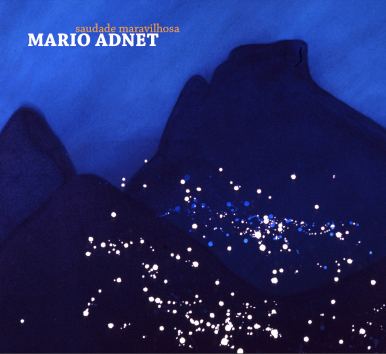
Mario Adnet
Saudade Maravilhosa


By Egídio LeitãoIf you have been following our site for a while, the name of Mario Adnet is not going to be unknown for you. His discography and special projects have been keeping us pleasantly busy. It is always a joy to find out he has a new album in the works, and it’s even better when we get to hear what he has released.
In Saudade Maravilhosa we get to hear more of Mario Adnet’s composer abilities. Although he’s had original tracks in previous albums, here eight out of the ten tracks are his own compositions. These original tracks bring back all the influences in Mario’s career. The listener can hear echoes of Tom Jobim, Villa-Lobos, Moacir Santos and other composers who were the focus of Mario’s refined arrangements and extensive productions. The same quality we have experienced in the past is, of course, abundant in Saudade Maravilhosa.
The musicians who accompanied Mario previously in other releases all return for this album. Produced together with Antonia Adnet, and with Mario’s own musical direction and arrangements, Saudade Maravilhosa assembles a team of experts all very familiar to us. You will hear Jorge Helder (double bass), Rafael Barata (drums), Marcos Nimrichter (piano, fender rhodes), Armando Marçal (percussion), Eduardo Neves (tenor and soprano saxophone, flute, alto flute), Aquiles Moraes (trumpet, flugelhorn), Everson Moraes (trombone), Cristiano Alves (clarinet), Ricardo Silveira (guitar), João Cavalcanti (vocals) and Leonardo Amuedo (guitar). With these heavyweights, nothing could go wrong, naturally.
With the exception of one vocal track, all others are delightful instrumental music. Two tracks have been previously recorded by Mario. The first is “Chorojazz,” which appeared in his 1999 Para Gershwin e Jobim album. The second is “Sambaqui,” which was in his 2001 Rio Carioca under a different title, “Sete Rios.” In this new recording, two top-notch guitarists, Leonardo Amuedo and Ricardo Silveira, take center stage and bring lots of fun to the arrangement. One big repertoire surprise is the inclusion of “Caravan.” Mario’s emphasis has often been to feature Brazilian music in his albums. However, as he explains it in the liner notes, he wanted to “show how Duke Ellington would sound like with a Moacir Santos‘ face.” The result is amazing, especially because of Armando Marçal’s percussion and the trumpet/trombone addition from the brothers Aquiles and Everson Moraes, respectively. Another clear Moacir Santos’ influence is the opening track, “Ancestral,” dedicated to Armando Marçal. The Afro theme in the composition gave Mario the impetus to create the arrangement as is. Once again, Armando Marçal is present with his vibrant percussion. From an Afro influence to choro, we move to “Cecilia no Parquinho,” inspired by Mario’s grand-daughter. He captures the happy moments he spends with her in this cheerful melody. Also worth to note is the gorgeous soft Bossa “Saudade Maravilhosa,” which takes us back to a nostalgic Rio de Janeiro with the allusion to Cidade Maravilhosa in its title (Rio’s nickname, Marvelous City).
Saudade Maravilhosa is a fine addition to a growing and solid discography. Great arrangements and musicianship flourish in an unpretentious set. Selo SESC says that by the end of 2017 the album should be available in all the usual streaming sites. For now, you have two options to grab this excellent album: buy the physical CD or listen to the tracks in the Selo SESC YouTube channel. If you opt for the latter, please note that the album is played twice in that stream.


Robert Glasper
Covered


By Bill Beuttler
Robert Glasper’s plunge into the world of R&B and hip-hop widened his fan base and earned him a pair of Grammy Awards, but he found himself missing the piano. So he reconvened his original acoustic trio with bassist Vicente Archer and drummer Damion Reid and cut Covered: The Robert Glasper Trio Recorded Live at Capitol Studios. Like Herbie Hancock before him, Glasper demonstrates on his new disc that jazz stars who indulge a taste for popular music can go home again.
Glasper’s piano here is as immediately identifiable as ever: deeply soulful, emphasizing vibe over show-offy virtuosity. That formula dominates a half-dozen sophisticatedly listenable jazz covers of artists ranging from megastars Radiohead (“Reckoner”), Joni Mitchell (“Barangrill”) and John Legend (“Good Morning”) to lesser-known Glasper associates Musiq Soulchild (“So Beautiful”), Jhené Aiko (“The Worst”) and Bilal (“Levels”). He brings more flash to bear on the lone jazz standard here, “Stella by Starlight,” but really reminds people what he is capable of instrumentally on “In Case You Forgot.” The latter chops showcase begins with Glasper, unaccompanied, blazing his way through lighting-quick runs and a kind of space-age stride with pauses for quick, mood-lightening quotes of Bonnie Raitt’s “I Can’t Make You Love Me” and Cyndi Lauper’s “Time After Time.” Archer and Reid each get their lone, memory-jogging solos on this one as well.
Two socially conscious tunes close the album. Harry Belafonte’s raspy recitation of his life story on “Got Over” is aimed at inspiring listeners, particularly those of color, to follow his lead in overcoming humble origins to achieve greatness. Glasper’s spin on Kendrick Lamar’s “I’m Dying of Thirst” features the pianist’s 6-year-old son, Riley, and other children reading the names of recent black victims of shootings by police.

Saturday, June 23, 2018

Rebecca Paris ( 1951 - 2018 )


By Andrew R. Chow at NYTimes
Rebecca Parris, a husky-voiced jazz singer known for both her blistering scat runs and her deeply affecting interpretations of ballads, died on June 17 in South Yarmouth, Mass. She was 66.
Her death was confirmed by her daughter, Marla Kleman, who said Ms. Parris had collapsed after a performance and was taken to Cape Cod Hospital, where she died. No cause was given, but Ms. Kleman said Ms. Parris’s health had been declining since 2004, when she had a heart attack and developed severe osteoporosis.
Ms. Parris was hailed by local journalists as “Boston’s first lady of jazz,” but over a four-decade career she also earned the respect of the jazz world at large, playing with luminaries like Dizzy Gillespie, Gary Burton and Buddy Rich. She performed at the Monterey Jazz Festival, the Blue Note in Greenwich Village, the Apollo Theater in Harlem and Tanglewood. She recorded 10 albums and was praised by some of her vocal heroes, including Sarah Vaughan and Carmen McRae.
“Her voice, a rich contralto with a baritone resonance, is so commanding that when a song’s attitude is combative, she can scare you,” Stephen Holden wrote in The New York Times in 2007, reviewing her performance at Birdland. “But when the mood is playful, she can also enfold you in a musical bear hug.”
It took Ms. Parris many years to find her footing as a jazz singer. She attended the Boston Conservatory to study opera, but dropped out and went to New York to pursue a career in musical theater. When she failed to land any significant parts, she went back to Boston and sang in a Top 40 cover band for a decade.
She saw a new path forward after sitting in on a few jazz gigs in Boston.
“It was like manna from heaven for me: lyrics and chord changes and sensible whole thoughts and beautiful ideas,” she said in 2008 when she appeared on the NPR show “Marian McPartland’s Piano Jazz.”
Her wrenching ballad performances and suave renditions of bossa nova standards earned her glowing reviews, increasingly prestigious bookings and the admiration of her colleagues. Her performance at the 1992 Floating Jazz Festival, a cruise across the Caribbean, caught the eye of Mr. Burton, the acclaimed vibraphonist. They recorded an album together, “It’s Another Day,” in 1993.
“She was very musical and had excellent taste in songs,” Mr. Burton said in a telephone interview. “She was underappreciated and underacknowledged.”
Rebecca Parris was born Ruth Blair MacCloskey on Dec. 28, 1951, in Needham, Mass., the youngest of three sisters. Her parents, Shirley Robinson and Ned MacCloskey, were both accomplished pianists; her father also taught English at Boston University. She grew up in Newton, Mass., and went to Newton South High School.
She took the stage name Rebecca Parris in the 1980s (the last name was inspired by the Cole Porter standard “I Love Paris”). She met the pianist Paul McWilliams in 1984 at a gig in Massachusetts, and the two remained partners until her death. Ms. Parris also adopted Ms. Kleman in 1997. In addition to Mr. McWilliams and Ms. Kleman, she is survived by her sister, Susan MacCloskey. Her marriage to Robert DeGrassie ended in divorce.
Ms. Parris settled down with Mr. McWilliams and Ms. Kleman in Duxbury, Mass., a suburb of Boston, and regularly packed local haunts like Regattabar and Scullers. She also taught private lessons and master classes.
Her osteoporosis caused her to lose six inches off her commanding height of six feet and required her to use crutches. But she never stopped performing.
She gave her last performance on a recent Sunday, sitting in with a trio that included Mr. McWilliams at the Riverway Lobster House in South Yarmouth. She sang two songs, “Old Devil Moon” and “There Will Never Be Another You,” on which she took an a cappella chorus.
“She sounded excellent,” Mr. McWilliams said of the performance. “When the band came back in, she was in perfect tune.”
A version of this article appears in print on June 25, 2018, on Page D11 of the New York edition with the headline: Rebecca Parris, 66, Jazz Singer Who Caught the Ear of Legends. Order Reprints | Today’s Paper | Subscribe

Sunday, June 17, 2018

1 Sem 2018 - Part Thirteen

Fred Hersch Trio
Live In Europe


By Dan McClenaghan
Fred Hersch's 2009 recording, Whirl (Palmetto Records), was where pure magic first occurred in the pianist's extensive and consistently superb discography. That particular outing introduced his now long-standing trio with bassist John Hebert and drummer Eric McPherson. Alive At the Vanguard (2012), Floating (2014), and Sunday Night At The Vanguard (2016) by the group followed, all on Palmetto Records.
For those who lauded Hersch's solo outing, Open Book (Palmetto Records, 2017) as his finest, most incisive and finely-focused outing, the pianist offers up Live In Europe, featuring his Hebert/McPherson team, to garner votes for that "Hersch's Best" slot.
Performed at Flagey Studio 4, in Brussels's former National Institute for Radio Broadcasting, Hersch was initially unaware that the set—which he regarded as one of his best trio performances ever—had been recorded. Upon finding out that it had been—and upon hearing the tape and having his belief in its extraordinary quality confirmed—he decided to release the music.
Spinning through Hersch's previous outings with this nine years and running trio says that they bring the "A" game every time. On Live In Europe it's an "A+" game. The players are as flexibly synchronized and adept at presenting their three-way improvisational and emotional expressionism as they could be, on a set that begins with a jittery take on Thelonious Monk's "We See." The group follows with six Hersch originals, including tributes to British pianist John Taylor and a calypso-esque nod to saxophone legend Sonny Rollins, before slipping into the Herbie Hancock songbook with the achingly beautiful "Miyako," that gives way to an effervescent take on a second Shorter tune, "Black Nile." It's a set where Hersch sounds freer, more open to possibilities, employing the same exploratory approach he presented on the epic "Though The Forest" on his Open Book outing.
And the sound must be addressed. It doesn't get any better—a big plus, especially on piano trio outings. The piano is crisp, like a winter sunrise. Every nuance of McPherson's intricate and energetic drumming has crystal clarity, and Hebert's empathic and emphatic bass lines come through with a clean-cut lucidity.
The show wraps it up with a solo encore of "Blue Monk," a sober and contemplative return to Monk-land, a place to which Hersch often travels.
Track Listing:
Wee See; Snape Maltings; Scuttlers; Skipping; Bristol Fog; Newklypso; The Big Easy; Miyako; Black Nile; Blue Monk.
Personnel: 
Fred Hersch: piano; John Hebert: bass; Eric McPherson: drums.


Dieter Ilg
B-A-C-H


By Jim Burlong
It is well over half a century since The Jacques Loussier Trio launched the first of their forty plus Bach themed albums upon the world. Although the French pianist enjoyed huge commercial success with the project, he had to bear the wrath of most critics and others within the music world. It is very unlikely that either fate will fall upon this trio of highly talented contemporary jazz musicians. The leader and bass virtuoso Dieter Ilg is from Offenburg in Germany. A graduate of The Manhatten School Of Music famed for his duo performances with saxophonist Charlie Mariano, solo projects and work with US heavyweights Mike Stern, Bob Berg and David Leibman. He also has fourteen albums to date under his own name. For the Bach project(s) he has called upon his fellow countryman, the award winning pianist Rainer Bohm who is a lecturer for the instrument at The Mainz University in Mannheim as well as the recipient of The New German Jazz Prize as soloist of the year for 2016. Completing the trio is drummer Patrice Heral from Montpellier in France who is one of the busiest rhythm players on the scene and has recently appeared within bands led by trumpet players Markus Stockhausen and Tomaz Stanko.
It is often said that "You cannot play jazz without playing Bach". This may well be so, but the problem could be where and when to improvise whist at least interpreting in some way the sentiments that the father of western classical music intended. Mr Ilg overcomes this problem perfectly by prefacing the title of each piece with the very important words "inspired by". Listeners will find that Rainer Bohm processes an exquisite touch on the keys, ideal for interpreting this music, while the leader's bass is strong and searching adding the jazz feel to proceedings. The drummers decorative cymbal work also complements the musical soundscape well. There is certainly more variation than improvisation throughout, but at the same time the excellent musicianship more than keeps interest alive. The four "Goldberg" pieces, the two Praludium's plus the strong melody of "Air" adapt best to the format. The technicality and structure here will certainly appeal to those with a good knowledge of Bach, although other ears may find the recording a little cold and academic.
Recorded, mixed and mastered by Adrian von Ripka at Bauer Studios, Ludwigsburg
von Ripka at Bauer Studios, Ludwigsburg
Recording date: January 15 & 16, 2017
Produced by Dieter Ilg
Executive Producer: Siggi Loch
Personnel:
Dieter Ilg / bass; Rainer Böhm / piano; Patrice Héral / drums


Charlie Watts
Meets The Danish Radio Big Band


By Nenad Georgievski
A film director once said that you can't make a great film with a weak script. The same goes for bands of any kind be it jazz or rock or any kind. You can't have a great band without a great drummer. A band can get by with an average bassist or guitarist, but not with an average drummer. It's the heartbeat of any band. One of the things that has made the band Rolling Stones what they are is drummer Charlie Watts and his exceptional and unusual drumming skills. For more than 50 years, Watts has been the propulsive engine that has driven this juggernaut. Few other drummers were as integral to the development of rock and roll music by creating rollicking grooves that were executed with an unhurried elan. Watts is a player you can listen to for his sound alone as he balances the smooth and the jagged with great ease. Contemporary musicians don't come much more graceful in sound or execution than that.
Apart from his long stint as the drummer of one of the most successful and certainly the longest running rock and roll band in the world, it's not a secret Watts's true love has always been jazz and that he has always had a deep appreciation and admiration for this music which hasn't been that much exploited by the press. During the '50s and '60s, Watts fell in love with jazz music through 78 rpm vinyls and the music of musicians like saxophonists Charlie Parker, Sonny Rollins, John Coltrane, Gerry Mulligan, trumpeter Miles Davis, to name but a few as well as the drummers they employed. Since then, he has been a passionate jazz aficionado whose knowledge about this music sits between the reverential and encyclopedic. During his sojourn with a marketing agency, he even penned an illustrated book about Charlie Parker as a tribute to him and has been collecting old drum sets used by drumming legends. During the day he would work at the agency and during the night he would play local gigs. And as many of his generation, he has learnt his trade both by listening to record and by observing jazz drummers in the London's London's jazz circles.
As a result, his drumming style has always been unorthodox and original. When he joined the Rolling Stones he used his jazz chops in order to invent his style of playing rock and blues rock that the Stones became known for and is the reason why he is so revered these days. When the Stones played in New York for the first time during their first American tour, he went to Birdland to see performances by his bassist Charles Mingus and saxophonist Sonny Rollins, and the latter would play years later with the Stones on a song named "Waiting on a Friend."
So it wasn't until the '80s and the '90s that Watts began fronting his own jazz bands whenever the demanding tours and work with the Stones would let him. Since then he has formed a number of jazz, boogie-woogie and big band outfits, including Rocket 88, the Charlie Watts Quintet and the Charlie Watts Tentet. Probably that is best portrayed in the thriller movie "Blue Ice" with actor Michael Caine playing a jazz club owner and Watts' band was the house jazz combo that brilliantly rocked the house. Charlie Watts meets the Danish Radio Big Band was instigated in 2009 by English trumpeter Gerard Presencer, who is also a member of the band. The Band had four days of rehearsals and then had a performance at the then newly opened Danish Radio Concert Hall in Copenhagen. All but two of the pieces here are rewrites of earlier, previously recorded selections either with the Rolling Stones or a selection of suits from his duet record with another drumming legend Jim Keltner. But to make a big band work has really very little to do with "star power" and has really everything to do with hard work. If it is played too conservative then everything will sound predictable and everyone will get bored. For a start, this record doesn't break any new ground. The emphasis is more on moods, harmonies and at moments the arrangements do nod at Gil Evans' or Mingus' styled approaches.
The date opens with two parts of "Elvin Suites" which as an original tune from the project with Kelter is a single composition. The original is an African styled piece with African harmonic voices meshed with piano flashes and cymbals. All of that is beautifully arranged here with dry hissing of Watts' brushes that drives the first part. It is indeed difficult to discern between what's arranged and what is spontaneous. The band's rapport is impressive and everything it plays sounds right. The second part emphasizes the drums and there are polyrhythmic runs that drive this piece with saxophonist Uffe Markussen taking the lead and soon the band steps on the gas and ups the game loud.
The Rolling Stones classics are beautifully rearranged and reharmonized. Nothing in these arrangements would hint at the original songs but a solo instrument would take a lead and directly reference the original melody. Even though named as "Faction" as soon as one hears the melody on the flugelhorn it becomes clear that this is "Satisfaction." Watt's subtle and non-flashy rhythm playing is utterly flawless and galvanizes the band. The same goes for the other two Stones classics "You Can't Always Get What You Want" and "Paint it Black." By no means is this a tribute of faithful recreations of these songs. The arranger shows a daring flair for reimagining these songs. Each of them is rethought and remodeled in order to come out with a vibrant new music. With its imaginative blend of melodies and grooves and colorful textures and timbres, these songs are a launchpad for the big band and its soloists to shine.
"I Should Care" is one of the hidden gems in this collection. There is a certain easiness and flow in this composition, but no blandness at all. The various soloists are stimulating and attentive conversationalists, always listening and often picking up on each other's quips. The album closes on a high note with a beautiful stomp "Molasses." Everything here is filled with movement. It's rich and sticky in rhythm and harmony and is exciting and boiling with energy.
This project feels good in the body and soul. The collaborative energy of this band is exhilarating and a joy to listen. More of this, please.
Track Listing:
Elvin Suite Part 1; Elvin Suite Part 2; Faction (also known as Satisfaction); I Should Care; You Can't Always Get What You Want; Paint It Black; Molasses;
Personnel:
Charlie Watts: drums; Per Gade: guitar,Anders Gustafsson: trumpet; Vincent Nilsson: trombone; David Green: acoustic bass; Peter Jensen: trombone; Steen Rasmussen: fender rhodes, piano; Uffe Markussen: tenor sax; Gerard Presencer: flugelhorn; Lars Møller: tenor sax; Steen Nikolaj Hansen: trombone; Nicolai Schultz: flute


The Jazz At Lincoln Center Orchestra
The Music Of John Lewis


By Mac Randall
When this live album was recorded at New York’s Frederick P. Rose Hall in 2013, Jon Batiste was a respected young pianist from New Orleans. Four years later, he’s that and the leader of a late-night talk-show band on a major network. His name recognition may have gone up, but it’s doubtful you’ll find him playing music like this—a stately set of nine compositions by John Lewis, with support from the Jazz at Lincoln Center Orchestra, in typically polished form—on Colbert too often.
Lewis and his Modern Jazz Quartet’s unique mix of rootsy blues and classical ambition is well suited to the JLCO’s repertory approach. All the same, the best moments here are the simplest. The opening “2 Degrees East, 3 Degrees West” keeps its early focus on Victor Goines’ expansive clarinet and Doug Wamble’s guitar, which sounds like it came straight from the swamp even before he applies a bottleneck slide. Batiste follows with a solo that zeroes in at first on a few short phrases, then a few notes, and then at last one note repeated over and over—a miniature clinic in the application of dynamics and the delicacy of touch.
Taking central position here are “La Cantatrice,” “Piazza Navona,” “Pulcinella” and “Spanish Steps,” from the MJQ’s 1962 suite The Comedy. One senses a case is being made for this as a major work, and the effort isn’t entirely successful; although the main theme of “Pulcinella” has an appealing spookiness, these pieces are just too all-over-the-place, with different styles, time signatures and tempos running into each other in herky-jerky fashion. “Delaunay’s Dilemma” is more satisfying, as Ted Nash’s alto saxophone slyly traces the outer fringes of the harmony. And Batiste’s unaccompanied take on “Django” is another standout, dizzying in its Rachmaninoff-ian romanticism.

Sunday, May 20, 2018

Jack Reilly ( 1932 - 2018 )


By Lynn René Bayley
Jazz pianist, educator and sometime classical composer Jack Reilly, who died this past Friday at the age of 86, was one of my oldest friends who I never met in person. Back in 1989, I started my own homemade music ‘zine devoted strictly to classical music and jazz, a forerunner of this blog. These were the early days of desktop publishing; I used a program called “Publish It!” which set up a three-column-per-page layout, used a hand-held scanner for pictures that converted good-looking photos into poor, grainy images to insert (in some instances I just did a cut-and-paste from the Schwann Catalog because it looked better), had copies made at the local Kinko’s, staple-bound each issue by hand and then sealed the binding with some sort of liquid elastic. It looked homemade and I never had more than 40 subscribers, but I kept it going for three years before I called it quits.
Jack sent me a copy of his early, home-bound copies of his “Species Blues” books (later professionally published by Hal Leonard) to review, but because I was so busy with the current issue I explained to him that I wanted to hold off on reviewing it until I had a chance to properly digest it. For some reason, he assumed I didn’t understand what he was talking about and so told me NOT to review it because I was too stupid. Well, that just ticked me off. I don’t claim to be competent at bookkeeping or building a ham radio, but if there’s one thing I do know, it’s music, so I delved into the three-book series and wrote a very positive and detailed review and sent it to him. He was awed by my analysis of his work, and from that moment on, we became friends.
But for whatever reason, Jack still decided to play me for a fool. He called me on the phone but said his name was Sean Petrahn, an Italian-Jewish jazz critic, and wanted to write reviews for my magazine. I was delighted to have him, even though I already had Ralph Berton and jazz trumpeter Jack Walrath as reviewers in the jazz field (I never was able to get any known names for classical reviews except for Terry Teachout, who I had met a decade earlier at the Aspen Music Festival). Jack/Sean wrote some very fine reviews for my ‘zine, but he kept playing me. He had his wife, Carol Lian, call me on the phone pretending to be Steve Allen’s secretary and asking me how she could get in touch with Sean because Steve wanted him on his TV show. Once I stopped publishing, he admitted the charade and we became real friends.
He was always supportive of me and I of him. I wrote good reviews of his CDs, which were not plentiful, and just couldn’t understand why this superb jazz musician wasn’t as well known as his early friend and colleague, Bill Evans, whose work his resembled in many ways. When he decided to release his series of spontaneous improvisations on the Aleister Crowley deck of tarot cards, “Tzu-Jan: The Sound of the Tarot,” he asked me to write the liner notes, for which he paid me. It was very welcome money, though not a large stipend. The funny thing was, once past his Sean Petrahn phase, we rarely talked on the phone in the intervening years, but we kept in touch via email almost up to the end.
Reilly’s work was consistently interesting. He didn’t lay into technique nearly as much as other jazz pianists, and perhaps this is what held back his popularity. People love flash in jazz pianists, and this Reilly would not do. His music was meaty and well-developed, one of his best works being the “La-No-Tib Suite,” which is Bitonal spelled backwards. He recorded a jazz version of the suite while his wife Carol, a fine classical pianist who also invented her own improvisations, recorded a classical version of it. He continued to send me his CDs to review, some of which appeared in Fanfare, as well as his Hal Leonard copies of Species Blues, The Harmony of Bill Evans and his last book, The Harmony of Dave Brubeck. Reilly’s musical analyses were detailed to a T and always extremely interesting. The Hal Leonard books also included CDs of him playing examples of various chord positions so that musicians could hear what he was writing about. In both books, while respecting the original works, Reilly included reharmonizations of their music in his own style.
When reviewing The Harmony of Dave Brubeck, I mentioned that during Brubeck’s active career many jazz critics lambasted him for his “pretentious” and “heavy-handed” playing style, which I never agreed with (I was a Brubeck fan from the moment Time Out first appeared in the early 1960s). Indeed, some critics even went so far as to approach alto saxist Paul Desmond and ask him why he didn’t just leave the quartet and go out on his own. Reilly was gracious enough to pass my comments on to Iola Brubeck, who wrote me back and commented that it was just the mindset of the time. I still have her email saved in my archive. He was also responsible for giving me Sheila Jordan’s email address, which led to my published interview of her.
Jack’s wacky sense of humor continued to the very end as well. I still have the hysterically funny meme he sent me of President Donald Trump, showing one of his signed executive orders. Over the real executive order, Jack had photoshopped an image directing all jazz musicians to learn to play bebop heads in all 12 keys…beginning with Charlie Parker’s Donna Lee. I knew he had been a cancer survivor, back in the early 2000s, but seemed to be in fairly good health until his final days.
In short, Jack Reilly was a wonderful musician and a loyal if somewhat quirky friend. He continued to send me links to jazz videos and great audio clips he had found online, and I did the same, once locating a late-1950s TV clip of the late George Russell leading a band which included Tony Scott on clarinet and Bill Evans on piano playing some of his pieces. Jack couldn’t thank me enough for that one. We also agreed that the late Clare Fischer, though recognized for his composing skills, was one of the most underrated jazz pianists of his time, and he gushed about the brilliance of the late Hall Overton as well. Reilly also sent me recordings of some of his classical compositions, which although they were well written I found a bit thick in texture and not altogether appealing, but by that time he had come to respect my musical judgment and so wasn’t really offended. I praised his jazz to the very end.
If you haven’t discovered Jack Reilly, and are a jazz fan, you need to search him out on YouTube and also collect some of his records. He was a superb artist whose work, like Mark Murphy’s, flew under the radar.

Saturday, May 12, 2018

1 Sem 2018 - Part Twelve

Seth MacFarlane
No One Ever Tells You


By Christopher Loudon
Four years ago, primetime animation kingpin Seth MacFarlane put his ardor for the Great American Songbook to the test, uniting with arranger and conductor Joel McNeely to record the breezy Music Is Better Than Words. The polished collection of Tin Pan Alley chestnuts and obscurities netted him a Grammy nomination.
MacFarlane and McNeely subsequently reunited for a platter of Christmas tunes. Though the press materials for this third teaming make no mention that the disc’s arrival coincides with Sinatra’s centenary, the timing can’t be accidental. The blueprint for these 17 tracks is clearly those mid-to-late-’50s classics-Only the Lonely, No One Cares, In the Wee Small Hours-that explored the somber flipside of Sinatra’s ring-a-ding-ding frivolity.
Backed by a wall of brass and a sea of strings, MacFarlane again succeeds admirably-as does McNeely, whose charts estimably echo Nelson Riddle and Gordon Jenkins. While he lacks Sinatra’s raw emotional wallop and more closely mirrors the mellow warmth of Dean Martin, he is no poseur. There’s plenty here from the Sinatra canon (including the title track, a last-minute addition to 1957’s otherwise upbeat A Swingin’ Affair! ). But there’s also ample room for MacFarlane to exercise his archaeological skills, digging up such gems as Cole Porter’s storm-clouded “Goodbye Little Dream Goodbye,” Henry Mancini and Carole Bayer Sager’s sweetly forlorn “Don’t Call It Love” (from the film 10) and, from Camelot, Lerner and Loewe’s wishful “Before I Gaze at You Again.”


Stacey Kent
I Know I Dream: The Orchestral Sessions 


By Dan Bilawsky
Stacey Kent has practically done it all over the past twenty years, selling north of two million albums, putting her gorgeously delicate stamp on standards, introducing fresh tunes into the canon, racking up awards, and bringing her flawless voice to fans in more than fifty countries. But one thing she hadn't done prior to this point is record an album with an orchestra. Cross that one off the list now and bathe your ears in this spellbinding music.
With I Know I Dream, Kent's voice receives a warm embrace from a sizeable orchestra containing nearly sixty musicians. But rather than force her to play up to sweeping peaks or grandiose ideals, the strings and winds manage to magnify the warmth and confidential tone endemic to Kent's work. Somehow, this influx of sounds leads to an even further dimming of the lights and sharpening of the emotional intent. It's intoxicating understatement at its finest.
Kent's sensitivity, grace, and multilingual savoir faire all contribute to this pleasure cruise. She serves as an expert tour guide through songs of love, moments of nostalgic reflection, and expressions of joy. Her voice can act as a ray of sunshine or a consoling hand, but above all it serves as a mirror for the heart.
Pieces like "Bullet Train," powered by a contemporary polish and groove, and "Make It Up," with a perky Brazilian flavor, both serve as aural pick-me-ups; forays into French—sly-turned-direct during Serge Gainsbourg's "Les Amours Perdues," emotionally gripping on Léo Ferré's "Avec Le Temps"—leave singular memories hanging in the mist; and scaled back settings like "I Know I Dream," where voice and piano commune with the moment before a stunningly gauzy orchestral draping is drawn around Kent, leave you breathless. Few singers can work their way into a lyric like this.
These arrangements—most by Tommy Laurence, a few involving Jim Tomlinson's hand with or without a partner—fit Kent like a glove, playing to her quiet strengths. The material is first-rate, with Jobim gems and French tearjerkers sharing space with appealing songs Tomlinson co-wrote with (either) Cliff Goldmacher, Kazuo Ishiguro, or Antonio Ladeira. And the musicians, of course, deserve high marks in working to the parameters of the Stacey Kent aesthetic. While this is but one more jewel in a discography with many, it's one that deserves singling out for its luster.
Track Listing: 
Double Rainbow; Photograph; Les Amours Perdues; Bullet Train; To Say Goodbye; Make It Up; Avec Le Temps; I Know I Dream; La Rue Madureira; Mais Uma Vez; That’s All; The Changing Lights.
Personnel: 
Stacey Kent: vocals; Jim Tomlinson: saxophones, alto flute, percussion; Graham Harvey: piano, Fender Rhodes, keyboard; John Paricelli: guitars; Jeremy Brown: double bass; Joshua Morrison: drums; Curtis Schwartz: electric bass (4); Erika Matsuo: station announcement (4); Martin Burgess: violin; Amanda Smith: violin; George Salter: violin; Katie Stillman: violin; Lorraine McAslan: violin; John Mills: violin; Andrew Storey: violin; Richard Milone: violin; Paul Wiley: violin; Rob Bishop: violin; Jenny Godson: violin; Catherine Morgan: violin; Matthew Ward: violin; Jeremy Morris: violin; Clare Hayes: violin; Richard Blayden: violin; Richard George: violin; Alison Dods: violin; Susan Briscoe: violin; Takane Funatsu: violin; Fiona Bonds: viola; James Boyd: viola; Ian Rathbone: viola; Nick Barr: viola; Chian Lim: viola; Reiad Chibah: viola; Martin Loveday: cello; Nick Cooper: cello; Will Schofield: cello; Judith Herbert: cello; Juliet Welchman: cello; Julia Graham: cello; Vicky Matthews: cello; Chris Laurence: bass; Richard Pryce: bass; Lucy Shaw: bass; Eliza Marshall: flute; Sarah Newbold: flute; Patricia Moynihan: flute; Siobhan Grealy: flute; Holly Cook: flute; Jamie Talbot: clarinet, alto flute; Time Lines: clarinet; Tom Lessels: bass clarinet; Steve Morris: contrabass clarinet; John Thurgood: French horn; Corinne Bailey: French horn; Joanna Hensel: French horn; Andy Sutton: French horn; Sue Blair: harp; Adrian Bending: vibraphone, percussion.


Van Morrison and Joey DeFrancesco
You're Driving Me Crazy


By C. Michael Bailey
Van Morrison has been busy, releasing three recordings in quick succession, Roll With the Punches (Exile, 2017), Versatile (Exile, 2017), and presently You're Driving Me Crazy with jazz organist Joey DeFrancesco. At this point in his career, Morrison can pretty well sing what he damn well pleases. On his past several recordings, Morrison has revisited his catalog, recasting some of his older songs in new frames and You're Driving Me Crazyproves no exception. Revisited here are "The Way Young Lovers Do" from Astral Weeks(Warner Bros, 1968), "All Saints Day" from Hymns to the Silence (Polydor, 1991), "Close Enough for Jazz" from Born to Sing: No Plan B (Blue Note, 2012).
The presence of Joey DeFrancesco must be noted for the refinement and aplomb he brings to Morrison's beautiful "Magic Time," infusing the piece with an easy-listening grace. The pair breath a gently-swinging life into Morrison's "Have I Told You Lately" (from Avalon Sunset (Mercury, 1989)), while recasting Inarticulate Speech of the Heart's "Celtic Swing" as a breezy romp featuring Morrison's alto saxophone and Dan Wilson's electric guitar. The pair lay down the blues on Morrison's "Goldfish Bowl" from What's Wrong with this Picture (Blue Note, 2003). It would not be fair to DeFrancesco to label this as a "Van Morrison" recording, but it is that. What DeFrancesco brings to the table is the integrating feature of his exceptional musicianship and swing. The two click best on the old war-horses: "Travelin' Light" and "Every Day I have the Blues" where their music making is effortless. And that is what we have become accustomed to from Morrison, music too easily made and enjoyed. It is not often that nature smiles so generously upon us, but it has done so in Van Morrison.
Track Listing: 
Miss Otis Regrets; Hold It Right There; All Saints Day; The Way Young Lovers Do; The Things I used to Do; Travelin’ Light; Close Enough for Jazz; Goldfish Bowl; Evening Shadows; Magic Time; You’re Driving Me Crazy; Every Day I have the Blues; Have I Told You Lately; Sticks and Stones; Celtic Swing.
Personnel: 
Van Morrison: vocals, saxophones; Joey DeFrancesco: Hammond organ, trumpet; Dan Wilson: guitar; Michael Ode: drums; Troy Roberts: saxophone.


Joey Alexander
Eclipse


By Geannine Reid
Pianist Joey Alexander knows how and when to strike the ivories. At the age of 14 he has already recorded two GRAMMY-nominated studio albums, My Favorite Things (Motema Music, 2015) and Countdown (Motema Music, 2016). Late in 2017, Alexander released Joey.Monk.Live! (Motema Music), a critically acclaimed surprise release to honor Thelonious Monk's centennial. Alexander has released his third studio album entitled, Eclipse. The eleven selections are mixture of originals and standards, demonstrating his aptitude as a composer (Alexander composed six of the eleven tunes), arranger, bandleader, and player. Joining Alexander is a rhythm section of bassist Reuben Rogersand drummer Eric Harland, and guest appearances by saxophonist Joshua Redman on three tracks.
Alexander's original "Bali" opens the disc in a celebratory mood, with a relaxed melody that has nice interaction between the bass and melodic figures. The Latin-ish straight eight feel is a perfect setting for Alexander's playful solo approach, and after Rogers mellow solo, Alexander begins the dance. His lines are clear and defined by clean phrasing and rhythm. He takes his time to build in intensity, developing each melodic fragment to a logical completion before moving on to the next idea. The trio has a very relaxed feel and joy about their playing and they are obviously are having fun playing together.
"The Very Thought of You" has guest artist Redman on the track. Alexander starts the tune of with a solo piano version of the melody. With intricate inner voice leading and smooth rhythmic styling, Alexander takes some very interesting harmonic turns, that are sure to delight. Redman enters and restates the melody; the duo is in symbiosis with each other and blend beautifully. Redman's solo is beautiful, his upper register work is impeccable. The two interact in a way that is conversational highlighting what a good listener Alexander is.
Eclipse is a wonderful third outing by Alexander. There is a nice range of tempos and feels, reflective moments and dramatic displays of virtuosity, and even moments of free group improvisation. Alexander is a confident and creative player that has a trio that converses with trust and respect. Adding the amazing sound of Redman, and you have a magical, musical journey. It's all about exploring the many possibilities of emotion that is Eclipse.
Track Listing: 
Bali; Faithful; Draw Me Nearer; Moment’s Notice; Blackbird; Eclipse; Fourteen; The Very Thought of You; Space; Time Remembered; Peace.
Personnel: 
Joey Alexander: piano; Ruben Rogers: bass; Eric Harland: drums; Joshua Redman: saxophone.

Wednesday, April 25, 2018

Bob Dorough ( 1923 - 2018 )


By Neil Genzlinger at NYTimes
Bob Dorough, a singer, pianist and composer who was well known for his jazz but even better known for “Schoolhouse Rock!,” an infectious series of song-filled cartoons that conveyed math and grammar principles to young viewers, died on Monday at his home in Mount Bethel, Pa. He was 94.
His wife, Sally Shanley, confirmed the death.
Mr. Dorough was a moderately successful jazz pianist and singer when an advertising man named David B. McCall approached him for help with an idea. Mr. McCall had wondered why his son was able to memorize lyrics to rock songs but couldn’t learn the multiplication tables. Would catchy math-related tunes be the answer?
The original concept was to make a record and workbook, but when Mr. Dorough started producing zippy songs like “Three Is a Magic Number” and “My Hero, Zero,” the vision expanded into a series of animated shorts, which ABC began inserting into its Saturday morning lineup in 1973.
The series continued into the mid-1980s, with several revivals in subsequent decades, the subject matter growing to include civics, science and, perhaps most impactfully, grammar.
“Not to unduly shame the American education system,” People magazine began an article in 2016, “but chances are Bob Dorough has had more of an impact on grammar fluency than any other individual in the 20th century.”
Mr. Dorough (rhymes with “thorough”; his wife said Thorough Dorough was a nickname) was music director for the initial series and also wrote and sang some of the most fondly remembered “Schoolhouse Rock!” songs. They apparently stuck in young heads, or parental ones, or both. For the rest of Mr. Dorough’s career, it was not uncommon for him to be playing a jazz set and have someone call for a “Schoolhouse Rock!” tune.
“Just about every concert we did we would do some ‘Schoolhouse Rock!’ because people enjoyed it,” Steve Berger, Mr. Dorough’s longtime guitarist, said in a telephone interview. The songs, he noted, were deceptively intricate.
“What you’ll notice is, each one of them is musically brilliant, is lyrically brilliant,” Mr. Berger said. The key, he said, was Mr. Dorough’s respect for the audience.
“He never wrote down to the kids,” he said. “He always brought them up.”
Robert Lrod Dorough was born on Dec. 12, 1923, in Cherry Hill, Ark. His father, Robert, was a salesman, and his mother, Alma Lewis Dorough, worked for a time for the Singer sewing machine company.
Music was always an interest for young Robert — violin and piano were among the instruments he studied as a child — but the idea of making a career of it really took hold when, as a clarinetist, he joined the high school band in Plainview, Tex., where his family had moved.
“That was when I fell in love with music,” he told The Arkansas Democrat-Gazette last year when he returned to his home state to play in Little Rock. “There was something about the ensemble, a lot of kids playing different horns, and it all fit like a glove when it was good. I said to my parents, ‘I’m going to be a musician.’ ”
First came military service, from 1943 to 1945; Mr. Dorough performed with and arranged for the Army Band. In 1949 he received a music degree at North Texas State Teachers College, then headed for New York, where he immersed himself in the jazz scene. His apartment on East 75th Street became the site of a regular jam session.
“You had to play early because of the neighbors,” he told The Philadelphia Inquirer in 1998. “They’d start knocking on the walls and floor at 10.”
The musicians, though, didn’t mind; the 10 o’clock quitting time meant they could still drop in on the late-night jazz scene downtown.
Mr. Dorough built a résumé that was nothing if not eclectic. In the early 1950s he was the traveling music director for the boxer Sugar Ray Robinson when Robinson tried a tap-dancing career. They were playing France when Robinson decided to return to the ring in 1955, but the Mars Club in Paris offered Mr. Dorough a singing and playing engagement, and he stayed for six months.
He returned to New York and recorded his first album, “Devil May Care,” released in 1956 on the small Bethlehem label. He moved to the West Coast for several years and was playing in a quintet at a Hollywood piano bar when he met Miles Davis, who would later ask Mr. Dorough to write him a Christmas song.
The result, in 1962, was “Blue Xmas (To Whom It May Concern),” a wry, somewhat cynical ditty sung by Mr. Dorough. (Another track from that session, “Nothing Like You,” was included on Davis’s 1967 album “Sorcerer.”)
Another quirky collaboration was “I’m Hip,” a tongue-in-cheek portrait of someone who is decidedly not hip, written with his fellow singer-pianist-composer Dave Frishberg. It became a signature song for Blossom Dearie.
Mr. Dorough also helped produce, arranged for, played on or contributed vocals to albums by an array of artists that included Hoagy Carmichael, the Fugs, Spanky and Our Gang, and Art Garfunkel. He even acted occasionally; he appeared in an episode of the western “Have Gun — Will Travel” in 1959.
By the time he was recruited for “Schoolhouse Rock!” he was well connected in the music world, and thus was able to bring a high-end assortment of talent to that project. Ms. Dearie sang “Figure Eight” and “Unpack Your Adjectives.” Mr. Frishberg wrote (and the jazz trumpeter and vocalist Jack Sheldon sang) one of the series’ most delightful songs, “I’m Just a Bill,”
Though Mr. Dorough recorded many albums over the years, his major-label debut did not come until he was 73, when Blue Note released “Right on My Way Home.”
In addition to his wife, Mr. Dorough is survived by a brother, Gregory; a daughter, Aralee Dorough; and a grandson. His first marriage, to Jacqueline Wright, ended in divorce in 1953. He married Ruth Corine Meinert in 1960; she died in 1986.
Mr. Dorough performed constantly throughout his career and was a regular at the Deer Head Inn in Delaware Water Gap, Pa., where he last played just a few weeks ago. In 2001, when he and Mr. Frishberg performed at the JVC Jazz Festival in New York, Ben Ratliff, reviewing the concert for The New York Times, said of Mr. Dorough, “He’s all eternal youth and love for life, with a ponytail, a toothy smile and a goofy charisma.”
That persona, complete with Arkansas twang, was no act, Mr. Berger said.
“What you saw on the stage,” he said, “was who Bob was.”
A version of this article appears in print on April 25, 2018, on Page B15 of the New York edition with the headline: Bob Dorough, Jazzman Who Composed ‘Schoolhouse Rock!’ Ditties, Dies at 94. Order Reprints | Today’s Paper | Subscribe